In my National Geographic article last year on carnivorous plants, I mentioned one particularly swift killer, the bladderwort. This aquatic plant grows little suction traps that can be triggered by passing animals. In a new paper in the Proceedings of the Royal Society, French researchers take the closest look yet at these ultrafast killers. They find that the door to the traps buckles like a popped bubble of chewing gum–but can then almost immediately swing back shut. Along with the new study on jumping fleas I wrote about last week, this is evidence of how far we’re just starting to explore the world of quick biology.

Science News has a nice write-up, and here is an excellent YouTube video provided by a co-author of the study, Philippe Marmottant, a physicist at Joseph Fourier University in Grenoble, France–complete with computer simulation, rubber-cap demos, and groovy soundtrack.

Originally published February 16, 2011. Copyright 2011 Carl Zimmer.
Over the weekend, Charles Darwin turned 202. I celebrated in Stony Brook on Long Island–which just so happens to be a very appropriate place to mark the event. Stony Brook University was the intellectual home of one of Darwin’s most important followers, the scientist George Williams. Williams may not be a household name, but for evolutionary biologists he looms large. Some fifty years ago, he framed some of the most important questions they are still seeking to answer today.

Continue reading “The Price of Youth: My Darwin Day 2011 Lecture”

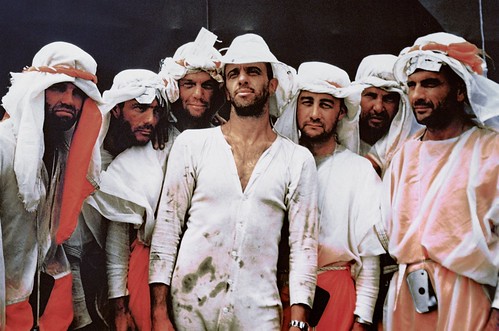
NASA has selected some great pictures for Flickr. Here’s the caption for the image above, “The Original Seven”:

In this 1960 photograph, the seven original Mercury astronauts participate in U.S. Air Force survival training exercises at Stead Air Force Base in Nevada. Pictured from left to right are: L. Gordon Cooper, M. Scott Carpenter, John Glenn, Alan Shepard, Virgil I. Grissom, Walter Schirra and Donald K. Slayton. Portions of their clothing have been fashioned from parachute material, and all have grown beards from their time in the wilderness. The purpose of this training was to prepare astronauts in the event of an emergency or faulty landing in a remote area. Forty-five years ago today on May 24, 1962, Scott Carpenter went on to fly the second American manned orbital flight. He piloted his Aurora 7 spacecraft through three revolutions of the Earth, reaching a maximum altitude of 164 miles. The spacecraft landed in the Atlantic Ocean about 1,000 miles, about 1,609 kilometers, southeast of Cape Canaveral after the 4 hour, 54 minute flight. Image credit: NASA

Hat tip: Steve Silberman

Originally published February 12, 2011. Copyright 2011 Carl Zimmer.

Seth Mnookin has written an important book chronicling one of the most tragic blasts of anti-science in memory: the fraud that was the autism-vaccine link. I asked Seth to come to Yale to talk about The Panic Virus, and he’ll be there on Thursday, February 17.

Here are the details:

February 17, 4 pm

Morse College Master’s Tea

Morse College Master’s House, 304 York Street, New Haven

Originally published February 10, 2011. Copyright 2011 Carl Zimmer.

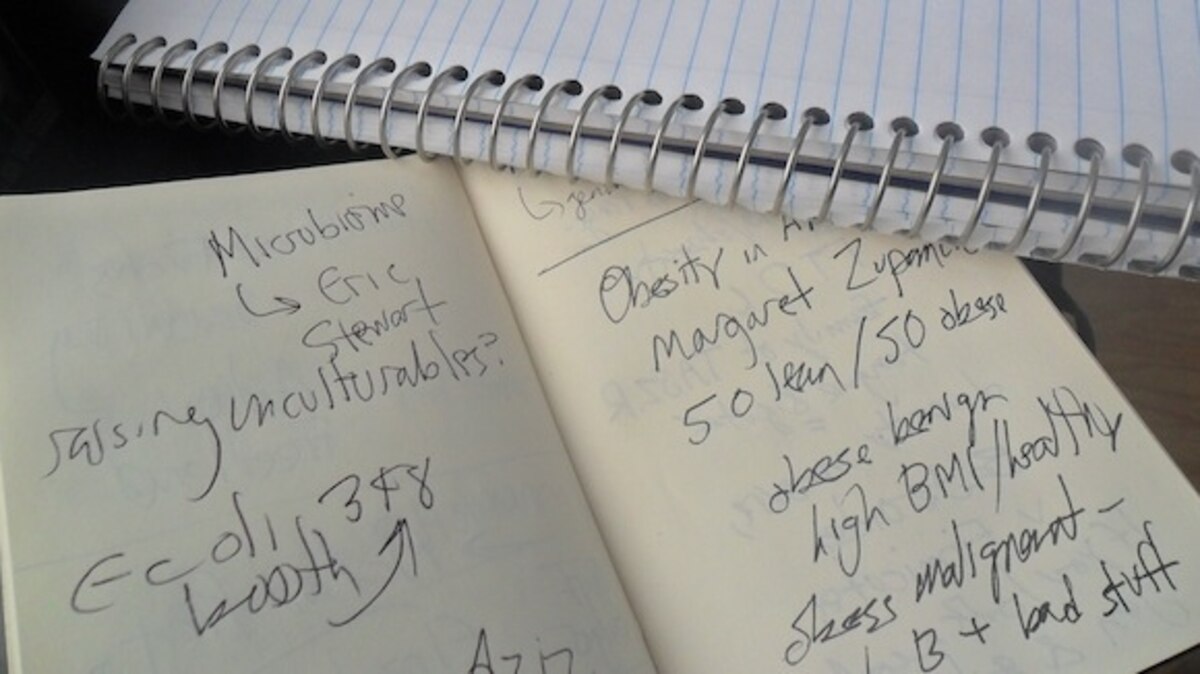
Siri Carpenter and Jeanne Erdmann have started a cool project called The Open Notebook, in which they talk to science writers about how they put together a particular story. For their latest dissection, they chose my New York Times story from last year on the microbes that swarm in our bodies. They talked to me about how I wrote that piece, and my approach to writing in general (short answer: chaos). They even included an audio excerpt from one of the interviews I did for the story. If you’re curious about the sausage around here gets made, check it out.

[Image: My microbiome Moleskine]