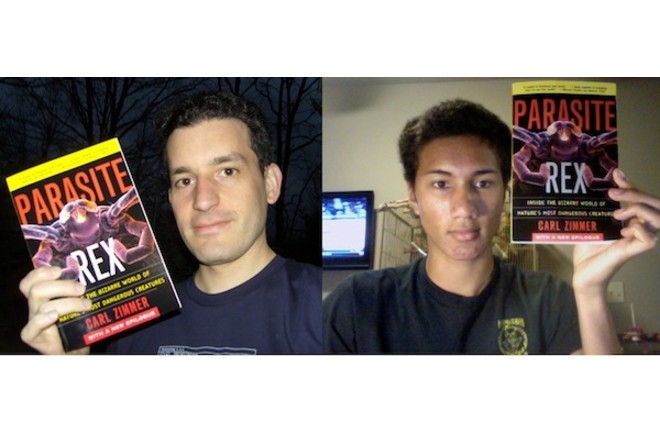
I’m heading into New Haven this evening to take part in The Ordinary Evening Reading Series. Tonight I’ll be talking about my upcoming book, A Planet of Viruses, and the writer Annie Murphy Paul will discuss her book Origins, which looks at how our experiences in the womb shape the rest of our lives. Join us at 7 pm tonight in the Mermaid Room at the Anchor Bar, 272 College St.

[Image: New Haven Advocate]

Originally published April 5, 2011. Copyright 2011 Carl Zimmer.

In tomorrow’s New York Times, I take a look into nature’s crystal ball. Scientists have long been warning that we may be headed into Earth’s sixth mass extinction. But most projections just carry forward the causes of recent extinctions and population plunges (overfishing, hunting, and the like). Global warming is already starting to have an effect on many species–but it’s a minor one compared with the full brunt that we may experience in the next century.

I’ve written in the past about studies scientists have carried out to project what that impact will be like. I decided to revisit the subject after reading a spate of provocative papers and books recently. While the scientists I talked to all agree that global warming could wreak serious havoc on biodiversity in coming decades, they’re debating the best way to measure that potential harm, and the best way to work against it. We all crave precision in our forecasts, but biology is so complex that in this case we may well have to live without it. Check it out.

[Image: Photo by DJ-Dwayne/Flickr]

Originally published April 4, 2011. Copyright 2011 Carl Zimmer.

If you’re a parent of a child with a developmental disorder, such as autism, ADHD, or Downs syndrome, you’re invited to a panel discussion I’ll be moderating in Guilford, CT, on Tuesday, April 26 at 6 pm. The panel will include doctors, researchers, and social workers. We’ll be discussing some of the most common questions parents have, on topics such as how developmental disorders are assessed, how early intervention helps children, and how parents themselves can cope with the challenges of caring for a disabled child.

The meeting will be hosted by SARAH, Inc., a non-profit agency serving the intellectually disabled in Connecticut. You can find more details about the meeting and the panelists on their web sitehere. To attend the meeting, register here. If you’d like to have the panel address a question, you can email the organizers, or post your question on their Facebook page. The event will be taped, and will be broadcast later here in Connecticut. Please spread the word to parents you think might be interested.

Originally published April 4, 2011. Copyright 2011 Carl Zimmer.

Each time you write a book, your publisher sends over a box of copies. Verging on ten books now, I’m getting overloaded with extras. And so, in the spirit of spring cleaning, I’ve set up a store on Amazon where you can find autographed, good-to-mint-condition copies of my books at reasonable prices. So please check out http://www.amazon.com/shops/carlzimmer

[Update, Monday 4/4 5 pm: Gah! The orders started coming in, and suddenly Amazon stores seem to have gone down. I hope they’ll be back up soon. I’ll update. Update, minutes later: And we’re back.]

[Image: Photo by Valeshel – Flickr]

Originally published April 4, 2011. Copyright 2011 Carl Zimmer.

The New York Times, April 4, 2011

Link

Over the past 540 million years, life on Earth has passed through five great mass extinctions. In each of those catastrophes, an estimated 75 percent or more of all species disappeared in a few million years or less.

For decades, scientists have warned that humans may be ushering in a sixth mass extinction, and recently a group of scientists at the University of California, Berkeley, tested the hypothesis. They applied new statistical methods to a new generation of fossil databases. As they reported last month in the journal Nature, the current rate of extinctions is far above normal. If endangered species continue to disappear, we will indeed experience a sixth extinction, over just the next few centuries or millennia.

Continue reading “Multitude of Species Face Climate Threat”