Long, long ago–actually, in 2006–I wrote an article for the New York Times about a very strange relative of today’s alligators and crocodiles. Effigia, which lived 210 million years ago, did not slouch around inTriassic swamps. Instead, it stood on two big hind legs, holding its front legs–arms, really–aloft. It looked an awful lot like a bipedal dinosaur, despite the fact that the ancestors of dinosaurs and crocodiles split off 250 million years ago.
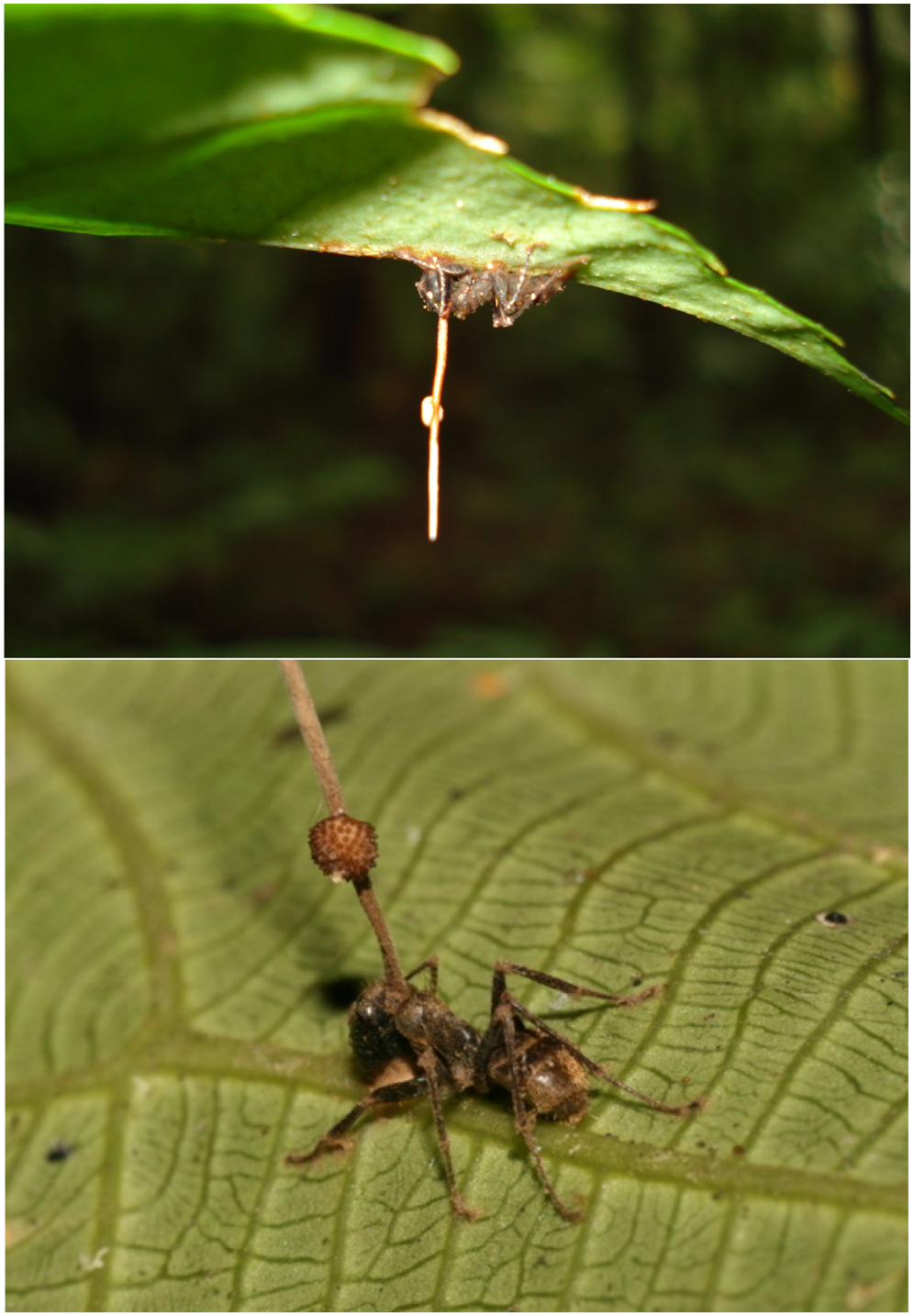
It’s time to pay another visit to Cordyceps, the fungus that turns its hosts into spore-sprouting zombies.
The fungus, which can be found in many parts of the tropics, penetrates an insect’s exoskeleton and then work its way into its host’s body. At first the ant seems normal to the human eye, but eventually it makes its way to a leaf, where it clamps down with its mandibles. Cordyceps then sprouts out of the ant’s body, lashing it to the leaf’s underside, and producing a long stalk tipped with spores. The spores can then shower down on unfortunate insects below.
The outbreak continues…
1. On Friday, I talked to Ira Flatow about A Planet of Viruses. The podcast is now available here.
2. I also spoke to the Guardian’s Alok Jha for their Science Weekly podcast. You can listen to that here.
3. Tomorrow around 9:30 am EST I’ll be on Newstalk, an Irish radio network.
4. Thursday I’ll be giving a lecture at California State University Fresno.
5. Sunday I’ll be talking about the book in Los Angeles and Irvine CA. Details here.
Originally published May 9, 2011. Copyright 2011 Carl Zimmer.
The folks at CreatureCast have created a new animation about the weirder corners of zoology. Behold Symbion pandora, an animal that clings to the mouthparts of lobsters, where it engages in the weirdest sex life I’ve ever heard of.
Originally published May 9, 2011. Copyright 2011 Carl Zimmer.
I’m pleased to report that I’ve just been appointed to the board of directors of the Council for the Advancement of Science Writing. It’s a venerable organization that’s been around for fifty years, dedicated to improving the quality of science news reaching the public. Their programs include the New Horizons in Science briefing, which brings together leading scientists with journalist to talk about cutting-edge research. We’re already scheming about some new ideas to use twenty-first century tools to help science writers–and readers–in new ways. I’ll keep you posted.
Originally published May 9, 2011. Copyright 2011 Carl Zimmer.