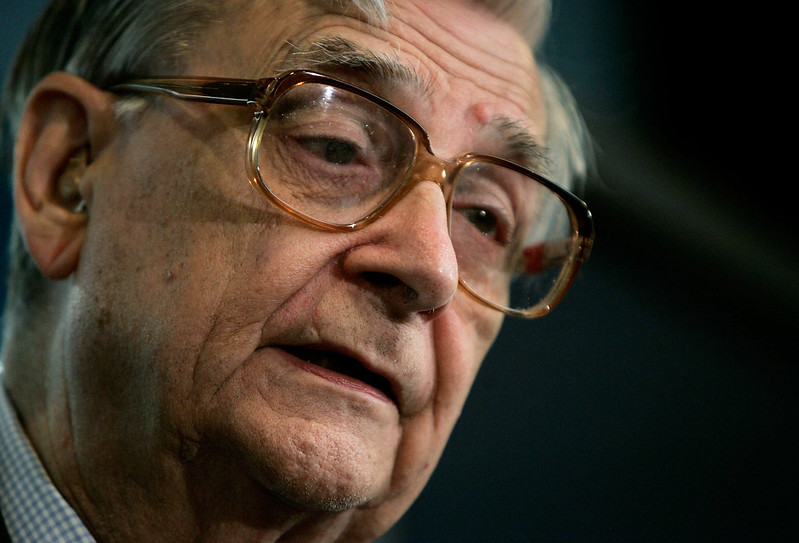
Smithsonian recently asked me to interview Harvard biologist E.O. Wilson about his new book, The Social Conquest of Earth. You can read the Q & A on their web site.

Wilson and I spoke for quite a while, covering wide range of subjects. One particularly interest part of the talk addressed his ongoing attack on a major aspect of modern evolutionary theory, known as inclusive fitness. I reported on his attacks–and the response of his critics–in the New York Times in 2010.

Continue reading “A Smithsonian Q & A with E. O. Wilson: complete with outtakes” →

Our 80 billion neurons form an estimated 100 trillion connections. Through those links surge the signals that make thought possible. Sebastian Seung of MIT has been calling for a full-blown atlas of those connections, because he believes it will help us understand how the brain works and how the brain makes us who we are. In the April issue of Discover, I pay a visit to Seung’s lab to see what he’s up to, and what he hopes for the future. Check it out.

I couldn’t be happier that this column is available a couple weeks before Seung will participate in a public debate about the connectome on April 2, hosted by myself and Robert Krulwich of Radiolab. The tickets were all snapped up about an hour and a half after becoming available online, but I will certainly report back afterwards about how it went.

Originally published March 21, 2012. Copyright 2012 Carl Zimmer.

Discover, March 20, 2012

Link

If I didn’t know Sebastian Seung was a neuroscientist, I would have pegged him as a computer game designer. His onyx-black hair seems frozen in a windstorm. He wears black sneakers, jeans, and a frayed bomber jacket over an untucked shirt covered in fluorescent blobs. If someone had blindfolded me on Vassar Street in Cambridge, Massachusetts, led me into Building 46 on the campus of MIT, past the sign that says Department of Brain and Cognitive Science, taken me up in the elevator to the fifth floor and whisked off the blindfold in Seung’s lab, I still wouldn’t have guessed he had anything to do with brains.

Continue reading “The Connections May Be the Key” →