This post was originally published in “Download the Universe,” a multi-author blog about science ebooks edited by Carl Zimmer.

Switzerland. By Sir Frank Fox. Originally published by Adam and Charles Black, 1914. 

Reviewed by Veronique Greenwood

October 28, 2013

Continue reading “Get Out Your Monocle! Exploring the Past in the Public Domain”


Source: http://biol.lf1.cuni.cz/navody/molbiol1/genetic_code.jpg

One of the strangest episodes in the history of biology occurred in 1953. A physicist named George Gamow, who is best known for his work on the Big Bang, sat down and read a new paper by two biologists named James Watson and Francis Crick. They reported that DNA is arranged as a double helix. Gamow then wondered how DNA encodes proteins. DNA used four “letters” in its genes, while proteins are built from a chemical alphabet of twenty amino acids. He realized that the question turned life into a problem in cryptography. Continue reading “The Code of Life: My New Feature for Nautilus Magazine”

The New York Times, October 24, 2013

Link

Around 1.8 million years ago, human evolution passed a milestone. Our ancestors before then were little more than bipedal apes. Those so-called hominids had chimpanzee-size bodies and brains, and they still had adaptations in their limbs for climbing trees. But the fossils of hominids from 1.8 to 1.5 million years ago are different. They had bigger brains, flatter faces and upright bodies better suited to walking.

Their geography changed, too. While earlier hominid fossils have only been found in Africa, the newer ones also turn up at sites stretching across Asia, from the Republic of Georgia all the way to Indonesia.

Continue reading “Christening the Earliest Members of Our Genus”

This post was originally published in “Download the Universe,” a multi-author blog about science ebooks edited by Carl Zimmer.

Sea Change. By Steve Ringman and Craig Welch. Published by Seattle Times.

The Course of Their Lives. By Mark Johnson and Rick Wood. Published by Milwaukee Journal-Sentinel. 

Reviewed by Carl Zimmer

October 24, 2013

Continue reading “Snowfallization”


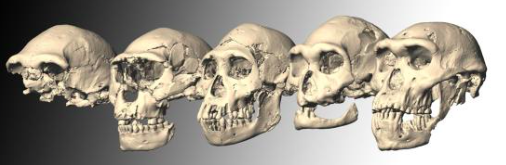
FIVE 1.8 MILLION-YEAR-OLD SKULLS FROM DMANISI, GEORGIA. IMAGE COURTESY OF M. PONCE DE LEÓN AND CH. ZOLLIKOFER, UNIVERSITY OF ZURICH, SWITZERLAND

Last week, scientists published a study of five 1.8 million-year-old hominid fossils. They may reveal profound lessons about a crucial chapter in our evolution: how our ancestors changed from bipedal apes to a more human-like lineage–in other words, the emergence of our genus, Homo. So what name do we give these skulls? What species do they belong to? It’s no simple matter naming our hominid ancestors, and that difficulty tells us something intriguing about their biology. And that’s the subject of my “Matter” column this week in the New York Times. Check it out.

Continue reading “Naming Our Ancestors: My New Column for the New York Times”