The New York Times, September 1, 2014

Link

In the history of biology, two little animals loom large.

In the early 1900s, scientists began studying Drosophila melanogaster, the common fruit fly. Research on these fast-breeding insects revealed that genes lie on chromosomes, which turned out to be true for other animals, including us. For more than a century, scientists have continued to glean clues from the lowly fly to other mysteries of biology, like why we sleep and how heart disease develops.

In the 1960s, another unassuming animal joined biology’s pantheon: a tiny worm called Caenorhabditis elegans.
Continue reading “Tiny, Vast Windows Into Human DNA”

If you’re looking for something to read this weekend, here are a couple pieces I’ve written in the past few days:

1. Epigenetics are cool. Mind-controlling parasites are cool. Epigenetics + mind-controlling parasites = Very cool. That equation is the subject of my latest column for the New York Times.

2. Tomorrow marks the 100th anniversary of the extinction of the passenger pigeon. In honor of that event, I’ve written a piece for National Geographic News about why its demise still means so much to scientists a century later.

For more on the passenger pigeon, check out this previous post from the Loom, as well as this feature I wrote last year for National Geographic. A number of other writers are also marking tomorrow’s anniversary–for example, Elizabeth Kolbert at the New Yorker,  David Biello at Scientific American, and John Fitzpatrick in the Sunday Review section of the New York Times.

Continue reading “Catching up: A Hundred Years Without Passenger Pigeons, and the Secrets of the Puppet Masters”

National Geographic, August 30, 2014

Link

People coming to the zoo to see the last passenger pigeon were disappointed by the bird, which barely budged off its perch. As Joel Greenberg writes in his recent book A Feathered River Across the Sky, some threw sand into its cage to try to force it to walk around. But on that first day of September a century ago, Martha no longer had to put up with such humiliations.

It was a quiet end to a noisy species. As recently as the mid-1800s, deafening flocks of billions of passenger pigeons swarmed across the eastern half of the United States. But they proved no match for humans, whose rapidly advancing technology drove the birds to extinction in a matter of decades.

Continue reading “Century After Extinction, Passenger Pigeons Remain Iconic—And Scientists Hope to Bring Them Back”

The New York Times, August 28, 2014

Link

An unassuming single-celled organism called Toxoplasma gondii is one of the most successful parasites on Earth, infecting an estimated 11 percent of Americans and perhaps half of all people worldwide. It’s just as prevalent in many other species of mammals and birds. In a recent study in Ohio, scientists found the parasite in three-quarters of the white-tailed deer they studied.

One reason for Toxoplasma’s success is its ability to manipulate its hosts. The parasite can influence their behavior, so much so that hosts can put themselves at risk of death.

Continue reading “Parasites Practicing Mind Control”

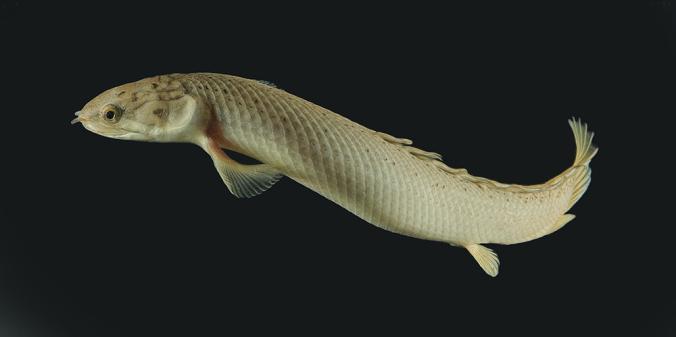
POLYPTERUS SENEGALUS (THE SENEGAL BICHIR). PHOTO BY ANTOINE MORIN

If you explore our genealogy back beyond about 370 million years ago, it gets fishy. Our ancestors back then were aquatic vertebrates that breathed through gills and swam with fins. Over the next twenty million years or so, our fishy ancestors were transformed into land-walking animals known as tetrapods (Latin for “four feet”).

The hardest evidence–both literally and figuratively–that we have for this transition comes from the fossil record. Over the past century, paleontologists have slowly but steadily unearthed species belong to our lineage, splitting off early in the evolution of the tetrapod body. As a result, we can see the skeletons of fish with some–but not all–of the traits that let tetrapods move around on land. (I wrote about the history of this search in my book At the Water’s Edge; for more information, I’d suggest Your Inner Fish, by Neil Shubin, who discovered Tiktaalik, one of the most important fossils on the tetrapod lineage.)

Continue reading “Evolution’s Baby Steps”