The future of bees may depend on understanding their past.
Bees are in trouble, any entomologist will tell you. Honeybee colonies in the United States have suffered devastating losses in recent years. But colony collapse disorder, as it’s called, affects only the species kept in beehives — the European honeybee, Apis mellifera. There are almost 20,000 species of wild bees, and they aren’t faring well, either.
Nearly a third of bumblebee species in the United States are declining. In the Netherlands, more than half of the country’s 357 species of wild bees are endangered.
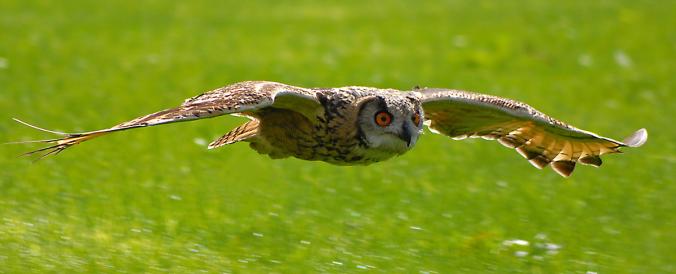
SIBERIAN TURKAMANIAN EAGLE OWL. CHRIS PAUL. CREATIVE COMMONS HTTPS://FLIC.KR/P/BJ2WHX
Feathers are like eyes or or hands. They’re so complex, so impressive in their adaptations, so good at getting a job done, that it can be hard at first to believe they evolved. Feathers today are only found on birds, which use them to do things like fly, control their body temperature, and show off for potential mates. The closest living relatives of birds–alligators and crocodiles–are not exactly known for their plumage. At least among living things, the glory of feathers is an all-or-nothing affair.
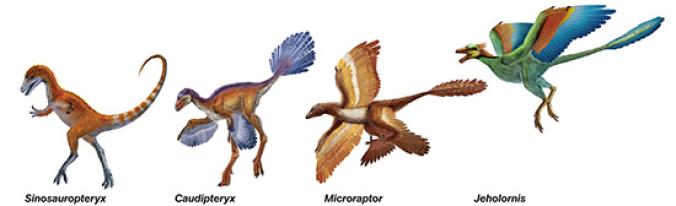
But the more we get to know feathers, the more we can appreciate how they evolved. The general rule is that complex things–be they feathers, hands, or eyes–take a very long time to evolve. As I wrote in National Geographicwrote in National Geographic in 2011, the fossil record has gone a very long way in helping us to understand how feathers took on the form we see today. Birds evolved from dinosaur ancestors, and those ancestors already had feathers. Feathers started out as simple filaments, turning to fuzz, and then diversifying into a lot of different forms–including the ones that eventually let birds take to the air.
A sampling of feathered dinosaurs and early birds. Xing Lida/National Geographic
Now a new study in the journal Molecular Biology and Evolution offers an even deeper look into the history of feathers. Instead of looking at fossils, the scientists look at the genetic recipe for feathers written in the DNA of birds. It turns out that a lot of that recipe already existed hundreds of millions of years before anything vaguely resembling a feather existed on Earth. In fact, you, my fine unfeathered friend, have most of the genetic information required for making feathers, too.
Scott Edwards, a Harvard ornithologist, and his colleagues couldn’t have carried out this study even a few years ago, because scientists have only recently figured out a lot of the details of how feathers develop. Bird embryos starts out featherless. But in their skin, they develop lots of tiny blobs of cells known as placodes in which cells are switching on genes in a distinctive pattern. The reason that certain genes switch on in the placodes and others don’t is that genes have little on-off switches near them. If a particular combination of proteins lands on a gene’s switch, the gene will start making a protein of its own.
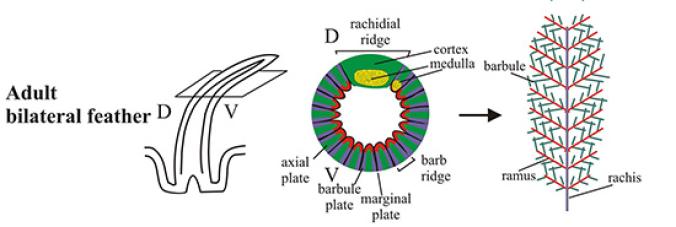
The development of a feather. The middle figure is a cross-section of the primordial feather shown on the left. Source: Ng et al 2012. PLoS Genet 8(7): e1002748
At first, the cells in the placodes multiply quickly. Then they start grow into shafts, which then split open to form feathers. Depending on the bird, and on the spot on the bird’s body where it grows, the feather may split into a downy plume, or into a paddle-shaped flight feather, or into an ornamental tail feather. Along the way, the cells differentiate, producing different combinations of proteins. The cells that make up the central shaft of the feather are stiffened with certain types of keratin, for example, while cells that are in the more delicate regions of the feather produce more flexible forms of the protein from different genes. Clusters of cells produce pigment molecules to give the feather colors and patterns. Every cell has an entire genome, which means it has all the genes for making any part of the feather. But its switches ensure that it only uses a certain combination of those genes.
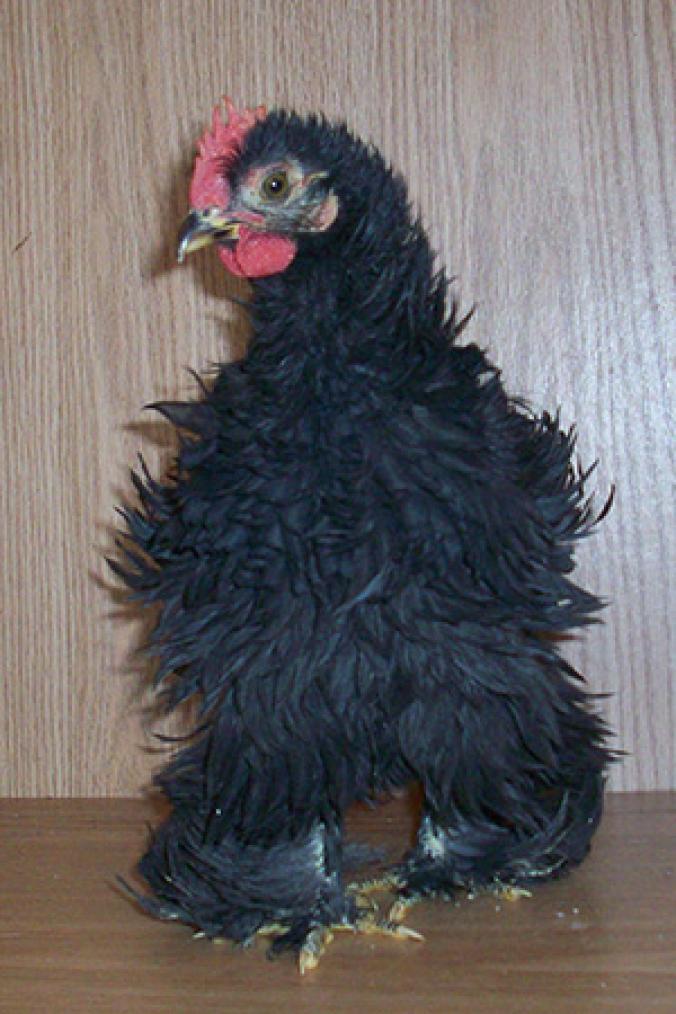
Frizzled chicken. Photo by Alisha Vargas via Creative Commons https://flic.kr/p/7XmQqu
Edwards and his colleagues combed the scientific literature for genes that are important for feather development. Scientists have studied frizzled chickens, for example, identified the mutation for the breed’s frizzles, and thereby identified a gene essential for developing feathers. All told, Edwards and his colleagues found 193 feather genes this way. Their list included 67 that encode variations of keratin, and 126 that help establish the pattern of feathers.
Next, the scientists searched for the switches that control those genes. This isn’t so easy. The switches are short stretches of DNA, often nestled deep inside much longer stretches of DNA that are just gibberish. What’s more, genes have distinctive segments that let you know you’re looking at a gene. The switches are much harder to distinguish from the gibberish.
The scientists used several strategies to zero in on the switches. They took advantage of the fact that most switches for a gene are close to the gene itself. So they only searched in the neighborhood of the 167 feather genes. They also took advantage of the fact that switches evolve relatively little, because most mutations will be harmful to them. So the scientists compared the DNA around feather genes in several different species and sought out the stretches that were noticeably similar from one species to the next. Using these two strategies, the scientists discovered a staggering 13,307 feather gene switches (technically known as conserved nonexonic elements, or CNEEs for short).
Next, the scientists asked when each part of this feather cookbook evolved. If they found a gene or a switch only in the DNA of birds, then they could be confident that it had evolved after the ancestors of birds split off from the ancestors of alligators and crocodiles. But if they found a gene or a switch in birds and alligators and crocodiles, then it must have evolved earlier, in their common ancestor.
(You may be asking, how did these new genes evolve? The short answer is that they can evolve through the duplication of old genes, or the transformation of genetic gibberish–a k a noncoding DNA. If you want to get more details, watch this TED-Ed video I wrote the script for.)
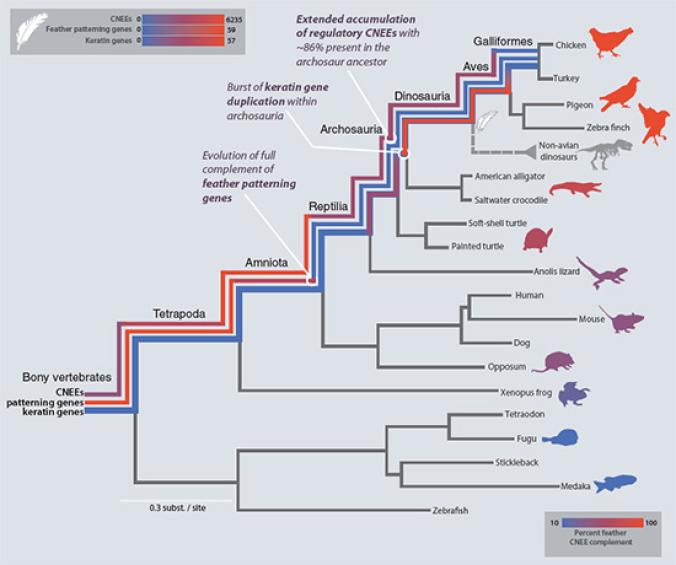
To see how far back the evolution of feather genes went, the scientists compared birds to a wide range of vertebrates, including humans, turtles, and pufferfish. They found that the instructions for making feathers got their start a long, long time before feathers themselves (see the tree at the bottom of the post or embiggen it here). The genes that establish the basic pattern of placodes already existed in the common ancestor of living fish and birds (and us)–in other words, about half a billion years ago. Even more feather genes evolved as our common ancestors climbed ashore and walked around on land 350 million years ago. Many switches for feather genes also emerged during this period, too.
About 300 million years ago, our ancestors began to lay hard-shelled eggs. Those early animals would give rise to mammals, reptiles, and birds (collectively known as amniotes, named for the amniotic egg). Edwards and his colleagues found that the first amniotes already had the entirecomplement of feather patterning genes. That means you, as an amniote, have them too.
Later, the early amniotes split away into their major lineages. The lineage that includes alligators, birds, and extinct dinosaurs–called archosaurs–originated about 250 million years ago. Edwards and his colleagues detected many new keratin genes evolving during the origin of archosaurs, along with 86 percent of their 13,000 or so feather gene switches.
It would not be another 100 million years or so before the oldest known birds flew. And yet just about everything you need to make a feather, genetically speaking, was already in place.
It may seem strange to consider the fact that you, as a mammal, have all the known genes required to pattern a feather, and yet you do not look like Big Bird. The reason for this discrepancy is that genes can do different jobs. Depending on where and when they make their proteins, they can build different kinds of anatomy. But it didn’t take much rewiring of genetic switches to turn the scaly skin of early reptiles into feathers. Indeed, the deep history of feathers could explain why paleontologists are finding so much evidence of simple feather-like filaments not just in dinosaurs, but in their close relatives like pterosaurs. Evolution was tinkering with the same toolkit.
Edwards and his colleagues noticed something else intriguing in the genomes of birds. They found a lot of switches that were not near feather genes, but were unique to birds. When the scientists looked for the nearest genes, they noticed that many of the genes help birds grow. They control the size of bird bodies, for example, or the size of their limbs.
This is an intriguing finding, because the fossil record reveals that as dinosaurs evolved into birds, their bodies shrank, while their arms got long for their size. The shift made it possible for birds to generate a lot of lift with big wings, which only had to keep a small body aloft.
Edwards and his colleagues may have found the molecular signature of that change. If they’re right, the cookbook for feathers is very old, but it took the evolution of a new kind of body for birds to use their feathers to fly.
When I talk about my book A Planet of Viruses, people often ask me if there are any viruses that are actually good for you. In an Ebola-obsessed age, it may be hard to imagine how the answer could be yes. But–yes! Or, at least, possibly yes. In my New York Timescolumn this week, I write about a provocative new study that suggests a virus can play the same nurturing role as the microbiome, encouraging the growth of a healthy gut and a robust immune system. Check it out.Continue reading “The Good Viruses?”→
When we talk about viruses, usually we focus on the suffering caused by Ebola, influenza and the like. But our bodies are home to trillions of viruses, and new research hints that some of them may actually be keeping us healthy.
“Viruses have gotten a bad rap,” said Ken Cadwell, an immunologist at New York University School of Medicine. “They don’t always cause disease.”
Dr. Cadwell stumbled by accident onto the first clues about the healing power of viruses. At the time, he was studying the microbiome, the community of 100 trillion microbes living in our bodies. Scientists have long known that the microbiome is important to our health.
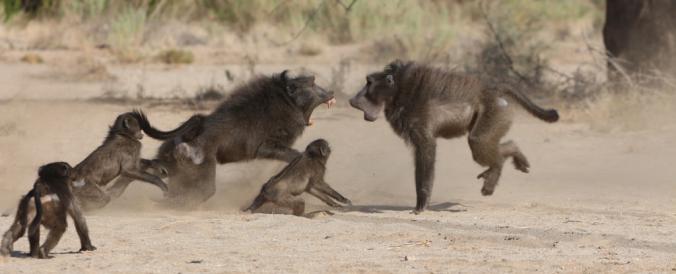
A MALE CHACMA BABOON THREATENS A FEMALE AND HER BABIES. PHOTO BY ELISE HUCHARD
Family life is fascinating–whether the family involved is made up of humans, monkeys, or hippos. Recently I’ve been exploring the complexities of mammal family life, and I’ve been thinking about what this research can and cannot tell us about our own experiences in families.
Last week in the New York Times, I wrote my column about some intriguing research on what happens when monkey mothers nurse their babies. Their milk doesn’t just deliver nutrients. It also has messages–different levels of hormones–that influence how babies develop, both physically and psychologically.