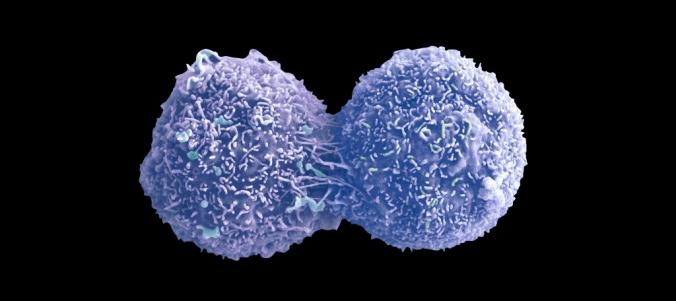
DIVIDING LUNG CANCER CELL. PHOTO BY ANNE WESTON, LRI, CRUK, WELLCOME IMAGES
Biologists who study cancer have been borrowing a lot of concepts from evolution in recent years. That’s because the changes that occur inside a tumor bear some striking resemblances to what natural selection does to a population of animals, plants, or bacteria. Evolutionary biologists who study societies–from human tribes to ant colonies–have investigated how cooperation can evolve when cheating can let some individuals get ahead. Now scientists are finding evidence of cooperation and cheating among cancer cells. In my column this week for the New York Timesmy column this week for the New York Times, I look at the social life of cancer–and how we might undermine it to fight the disease.
This video, made by the authors of a new study I write about in the column, presents the gist of this idea–of killing a tumor by creating a new tumor inside of it.
A tumor, as strange as it may sound, is a little society. The cancer cells that make it up cooperate with one another, and together they thrive.
Scientists are only starting to decipher the rules of these communities. But if they can understand how these cells work together, then they may be able to stop the tumor. “You can drive it to collapse,” said Marco Archetti, a biologist at the University of East Anglia and at the Icahn School of Medicine at Mount Sinai.
Cancer starts when healthy cells mutate and lose the safeguards that normally keep their growth in check. The cells start to multiply quickly, and their descendants gain new mutations, some of which make the cells even better at multiplying.
You wouldn’t think hellbenders would be hard to find: The huge salamanders, the biggest amphibians in North America, can grow up to 30 inches long. Yet hellbenders make themselves scarce, living on the bottoms of mountain streams, lurking under massive rocks.
As a result, locating hellbenders takes a crew of scientists. First, some of them must wedge a long pole under a rock to hoist it up, and then their colleagues must plunge into the chilly water to catch their quarry.
A couple of years ago, Stephen Spear, a conservation scientist at the Orianne Society in Athens, Ga., heard about a possible alternative.
In the standard Frankenstein story, a scientist creates an unnatural monster that breaks out of the lab and runs amok. But why should unnatural make something unstoppable? The contrary is possible, too. Imagine a different story: Frankenstein’s monster escapes, realizes that it can’t survive in the outside world, and retreats back to the lab. This story line may not make for a satisfying movie, but it might be a good goal for real life.
The fear of the unstoppable unnatural has been with us ever since scientists began moving genes between species in the 1970s. In a 1973 experiment, researchers transferred a gene from a frog into Escherichia coli. The gut microbe used the frog gene to make a frog protein.
It wasn’t long before researchers figured out how to use genetic engineering to turn microbes into factories. When scientists inserted the gene for human insulin into E. coli, the bacteria were able to manufacture a drug that had previously been harvested from cow pancreases. E. coli became the workhorse of biotechnology, spewing out drugs, vitamins, and industrial materials. (For more on E. coli’s strange yet significant history, see my book Microcosm.)
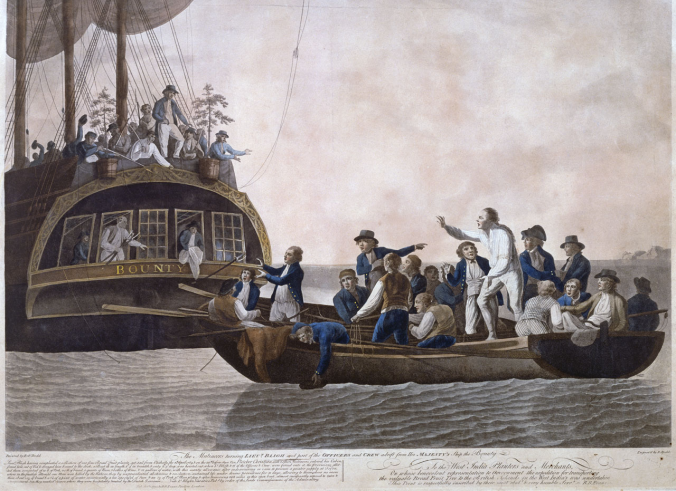
MUTINEERS TURNING CAPTAIN BLIGH AND OTHER SAILORS ADRIFT FROM THE BOUNTY. PAINTING BY ROBERT DODD. WIKIPEDIA
It’s an ugly fact of life that getting old means getting infections. Old people get attacked more by pathogens, and the damage that these germs cause can speed up the aging process, leading to even more infections. The standard explanation for this vulnerability is that the immune system falters in old age, opening an opportunity for pathogens to invade. But in the journal Biology Direct, Viktor Muller of Eotvos Unversity and his colleagues propose that something else is also going on in the aging body. Maybe the microbiome senses that its host is in bad shape and rises up in rebellion. The scientists call their idea “the Microbiome Mutiny Hypothesis.”
It may seem like a strange notion, but several lines of evidence suggest it’s worth considering. First of all, a lot of the pathogens that attack the elderly come from within. They grow quietly and harmless for decades inside people’s bodies and then switch over to causing dangerous infections later in life. The answer to why old people get infections must address why harmless bacteria turn bad in old age.
To understand this turn, we have to abandon any strict division between “good” germs and “bad” ones. For the germs themselves, these are just two ends of a seamless spectrum. Depending on how they use their host, microbes may cause no harm, a little, or a lot. And the virulence of a microbe–the amount of harm it causes–can itself evolve over time. Under some conditions, natural selection may favor gentle handling. But in other situations, causing deadly disease may be the winning strategy.
A lot of factors go into determining which strategy will be a winner for a given microbe. For some microbes, the best way to multiply may be ripping open host cells and feasting on their contents. This may kill a lot of their hosts, but that may not matter to the microbes, since they can escape to a new host–say, by causing diarrhea that contaminates a water supply. But in other conditions, killing a host may be a bad long-term strategy–if, for example, the odds are low that a microbe will get from one host to the next.
It’s even possible for organisms to evolve the ability to switch between these strategies, using the best strategy for different environments. In a 2013 experiment, Oxford scientists observed this switch evolve before their eyes.
They studied phages, which are viruses that infect bacteria. A phage invades a bacterium and makes new copies of itself. The bacterium eventually ruptures, spilling out the next generation of phages.
The scientists reared phages under unusual conditions–they mixed together a very high concentration of phages with bacteria. As a result, each microbe tended to get infected by more than one phage. The phages would then make copies of themselves at different rates. When the microbe ruptures, out would come a mixture of phages. The faster breeders dominated over the slower ones.
The scientists let the phages evolve in these conditions for 50 days. When they were done, the phages could now adjust their speed. If they found themselves alone in a host cell, they grew slowly. But if they sensed other phages in the cell, they sped up, so as to outcompete their rivals. As a result, their host died faster.
Muller and his colleagues propose that some of the microbes that live in our bodies can also switch from benign to deadly for similar reasons. While we’re healthy, they growing slowly, causing us no harm. But as we approach the end of our lives, the microbiome shifts to a more aggressive strategy.
“Killing the goose that lays the golden eggs might not be such a bad idea if the goose is going to die soon, anyway,” the scientists write.
There’s good evidence that microbial residents can eavesdrop on our health. A pathogen called Pseudomonas aeruginosa, for example, can sense certain molecules our brains release in response to stress. They respond by unleashing a toxin that help them grow–while also damaging our lungs.
Muller and his colleagues offer some ways to test their hypothesis. If they’re right, then infections in old age aren’t just the result of a slack immune system. Instead, bacteria and viruses sense a changed environment and respond by making new molecules, which they use to grow aggressively and cause harm. If scientists disable these molecules, then the pathogens should become tame again.
It would be interesting to see the Microbiome Mutiny hypothesis put to such a test. Conceivably, scientists could someday turn the test into a treatment. Rather than blasting the elderly with broad-spectrum antibiotics, doctors could just disarm the mutiny.
Originally published January 19, 2015. Copyright 2015 Carl Zimmer.