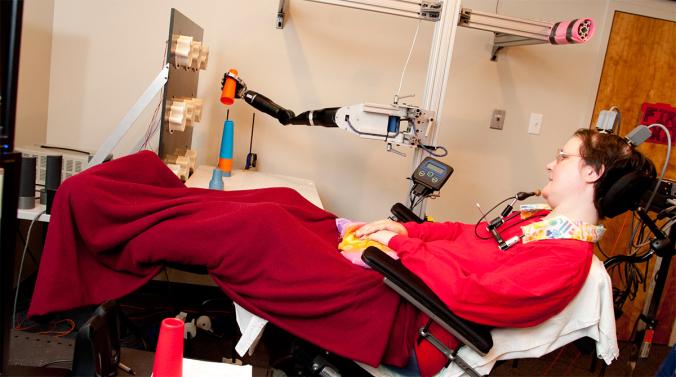
For many paralyzed people, their problem is a communication gap. They can generate the signals in their brain require to control their muscles–to walk, to wash dishes, to weed a garden. But damage to their nervous system prevents those signals from reaching their destination.
Last year, in a feature I wrote for National Geographic about the brain, I recounted the work of scientists and engineers who are trying to bridge that gap. Their dream is to create a technology that reads signals from people’s brains and uses them to control machines. The machines might be robot arms that people could use to feed themselves, or computers to compose emails, or perhaps even exoskeletons that could enable people to walk.
Scientists have been investigating these brain-machine interfaces for decades, and in recent years they’ve made some impressive advances–some of which I described in my story. But it would be wrong to giddily declare that scientists have reached their goal. You need only look at this picture below to get a sense of how far we are from science-fiction dreams.