The New York Times, September 21, 2016

Link

Modern humans evolved in Africa roughly 200,000 years ago. But how did our species go on to populate the rest of the globe?

The question, one of the biggest in studies of human evolution, has intrigued scientists for decades. In a series of extraordinary genetic analyses published on Wednesday, researchers believe they have found an answer.

In the journal Nature, three separate teams of geneticists survey DNA collected from cultures around the globe, many for the first time, and conclude that all non-Africans today trace their ancestry to a single population emerging from Africa between 50,000 and 80,000 years ago.

Continue reading “A Single Migration From Africa Populated the World, Studies Find”
STAT, September 12, 2016

Link

We may come to the end of antibiotics. We may run clean out of effective ammunition, and then how the bacteria and moulds will lord it.”

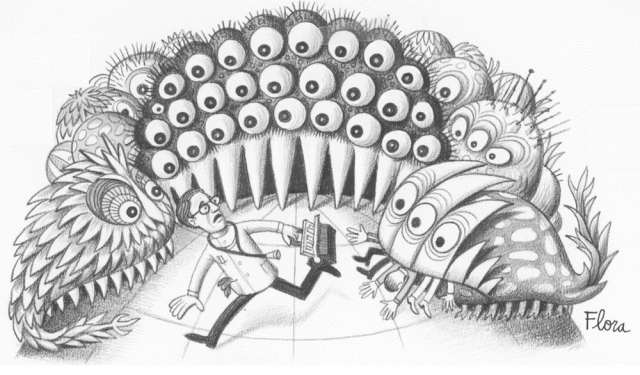
If you had to guess where those words came from, you might well say a recent news segment on TV, or perhaps an op-ed published by a frantic doctor. After all, these days there’s a lot of talk about our antibiotic resistance crisis. Bacteria that have evolved to withstand antibiotics kill 700,000 people each year, and ever more powerful strains are spreading around the world.

Continue reading “The surprising history of the war on superbugs — and what it means for the world today”

A Life (And Death?) In the Trees

You’ve probably heard about Lucy. She’s a 3.2-million-year-old relative of ours, a bipedal ape who only stood three feet tall. She’s famous for the discovery of her partial skeleton in 1974, a discovery that enabled scientists to learn a lot about her life, and about her species, Australopithecus afarensis. Now a team of scientists has put forward evidence about how she died: by a long fall from a tree. If they’re right, her death might actually tell us a lot about her life, too–and about how we evolved to walk upright. But hold on–as I wrote in the New York Times on Monday–a number of other experts don’t think the scientists have made a compelling case. Regardless of how she died, however, this research has led to something pretty exciting: you can download the 3-D scans of some of Lucy’s bones and print out replicas.
 

Continue reading “Friday’s Elk, September 2, 2016”

The New York Times, August 29, 2016

Link

In 1974, the paleoanthropologist Donald C. Johanson led an expedition to Ethiopia to look for fossils of ancient human relatives.

In an expanse of arid badlands, he spotted an arm bone. Then, in the area surrounding it, Dr. Johanson and his colleagues found hundreds of other skeletal fragments.

The fossils turned out to have come from a single three-foot-tall female who lived 3.2 million years ago. The scientists named her species Australopithecus afarensis, and the skeleton was dubbed Lucy.

Continue reading “A 3.2-Million-Year-Old Mystery: Did Lucy Fall From a Tree?”