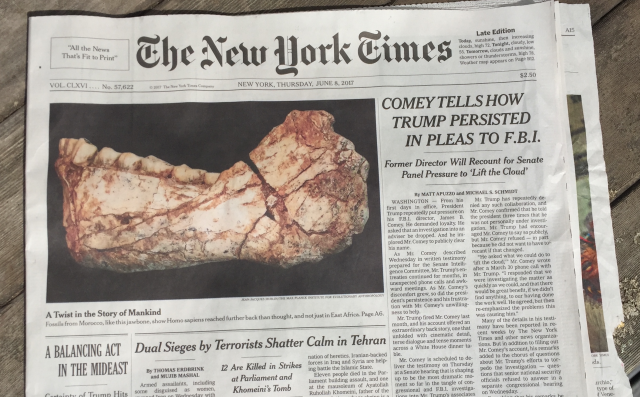
The New York Times, January 18, 2017

Link

Our fellow primates are in trouble.

In a study of unprecedented scope, a team of 31 primatologists has analyzed every known species of primate to judge how they are faring. The news for man’s closest animal relatives is not good.

Three-quarters of primate species are in decline, the researchers found, and about 60 percent are now threatened with extinction. From gorillas to gibbons, primates are in significantly worse shape now than in recent decades because of the devastation from agriculture, hunting and mining.

Continue reading “Most Primate Species Threatened With Extinction, Scientists Find”

Happy 2017! (I confess, I had to correct that from “2016” just before sending this out.)

This week I wrote a column about migrations. There’s something endlessly fascinating about migratory animals: namely, the huge amount of things we don’t understand about them. We’re not sure how they manage to make the same journeys every year. Sometimes it’s hard to know why they bother. Sometimes we don’t even quite know the course they take. Continue reading “Friday’s Elk, January 6, 2017”

Nautilus, January 5, 2017

Link

It’s hard to tell precisely how big a role biotechnology plays in our economy, because it infiltrates so many parts of it. Genetically modified organisms such as microbes and plants now create medicine, food, fuel, and even fabrics. Recently, Robert Carlson, of the biotech firm Biodesic and the investment firm Bioeconomy Capital, decided to run the numbers and ended up with an eye-popping estimate. He concluded that in 2012, the last year for which good data are available, revenues from biotechnology in the United States alone were over $324 billion.

“If we talk about mining or several manufacturing sectors, biotech is bigger than those,” said Carlson. “I don’t think people appreciate that.”

Continue reading “The Man Who Kicked Off the Biotech Revolution”

The New York Times, January 5, 2017

Link

Bird migrations have stumped the greatest minds for thousands of years. Aristotle thought that the robins living in Greece in the winter somehow turned into redstarts in the summer. In fact, robins migrate from Greece to Northern Europe around the time redstarts arrive from Africa.

Scientists have gotten a much better understanding of bird migration in recent centuries, but there’s a tremendous amount they have yet to learn. After tracking more than three dozen birds with sensors for thousands of miles, a team of researchers reported on Wednesday that their migration defied the expected course.

Continue reading “On Long Migrations, Birds Chase an Eternal Spring”

It’s hard to believe this will be the last Friday’s Elk of 2016. I just wanted to thank everyone for being curious enough about my work to clutter your inboxes with emails from me.

One of the advantages of sending out a semi-regular newsletter is that it’s easy to scan back over them and consider which experiences of this past year stood out.

This fall marked my one-year anniversary as a contributing national correspondent for Stat. Among the most satisfying features I wrote for them were a story about the struggle to find the molecular basis of memory, a piece about an experimental procedure to save a man’s life with viruses, and a three-part series about getting my genome sequenced. Continue reading “Friday’s Elk, December 23, 2016”