On today’s episode of Bloggingheads, fellow Discover blogger Chris Mooney and I talk about Unscientific America: How Scientific Illiteracy Threatens our Future
I have some hope for a happy coexistence between blogs about science and older forms of media. I don’t think blogs will ever supplant newspapers and magazines, nor I do I think they’re killing them like a parasite destroying its host. In fact, blogs may be able to act as a new kind of quality-control mechanism. I know that not all my colleagues on the old-media side of the divide are so optimistic. You’d be hard-pressed to find a snootier distillation of their scorn than something Independent science editor Steve Connor wrote recently:
Long after I’m dead, there will be stingrays swimming the Arafura Sea infested with tapeworms that bear my name.
There are about 1.8 million species with names, out of an estimated 8 to 9 million species in total. In 2007 alone, scientists named 18516 new species. Naming a species is actually the final step in a long, slow journey. It starts with the discovery of an organism that looks like it just might not belong to any known species. Scientists then search the scientific literature to see if it is indeed new to science. If it is, they inspect it in painstaking detail, observing all the information one might be able to use to identify another organism as belonging to the same species. This is not the sort of work a gene-sequencing robot can do for you on your lunch break. This is natural history, old school.
Last week, three teams of scientists published three massive studies in Nature on the genes behind schizophrenia. They scanned thousands of people to find variants of genes that tended to show up more in people with schizophrenia than in those without it. And they found a heap of genes. There are thousands of different variants that each may raise your risk of schizophrenia by a tiny amount.
Continue reading “Microcosm Week: Dreaming of a Complete Solution to Life”
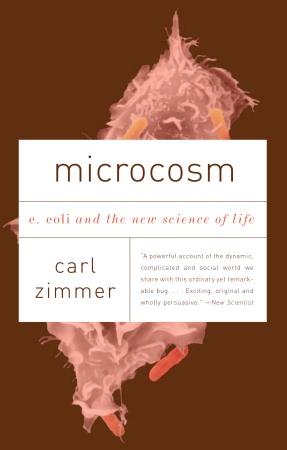
Next week the paperback edition of my book Microcosm: E. Coli and the New Science of Life will be published. In the book I approach E. coli as a microscopic oracle that can reveal great secrets about how life in general works. This is not actually a rhetorical stretch; over the past century scientists have put a spectacular amount of work into understanding this bug. And, as I write in the book, E. coli continues to offer surprises. In celebration of the arrival of the paperback Microcosm, I’m going to take a look at some fresh-out-of-the-oven research on E. coli that may change the way you think about life as a whole.
Continue reading “Microcosm Week: There’s Evolution In My Cookie Dough”