Two years ago I was invited me to participate in a weird but cool experiment. The author Robert Wright had set up an online talk show of sorts called Bloggingheads. Two people with something interesting to say–economists, political scientists, human rights workers, seasoned journalists, and others–would pick a topic. They would talk on the phone while filming themselves and then upload the recordings. Others could then watch them hold forth.

I loved the inventiveness of the format. I loved how a conversation could be embedded in any other site. I loved the way people would just talk for an hour rather than squeeze their points down to meaningless sound bites. And so even though it was just a volunteer gig, I dove in. It was took a while for me to get used to the medium–staring into the glass eye of a camera and pretending it was a human head just doesn’t come naturally to me. And crackly cell phone connections didn’t help. But on the best of occasions it was fun. It let me expand what I used to do only on the printed page. I had interesting talks with all sorts of interesting people, such as Craig Venter, Neil Shubin, and my brother.

But now my experiment’s over. This post is an explanation of why, and how this turn of events has gotten me thinking about the future of science in new media.

Continue reading “Bloggingheads and the Old Challenges of New Tools”
The New York Times, August 31, 2009

Link

Birds, more than any other group of animals, are a celebration of color. They have evolved to every extreme of the spectrum, from the hot pink of flamingos to the shimmering blue of a peacock’s neck. Yet, for decades, paleontologists who study extinct birds have had to use their imaginations to see the colors in the fossils. Several feather fossils have been unearthed over the years, but they have always been assumed to be colorless vestiges.

Now a team of scientists has discovered color-producing molecules that have survived for 47 million years in the fossil of a feather. By analyzing those molecules, the researchers have shown that they would have given a bird the kind of dark, iridescent sheen found on starlings and other living birds.

Continue reading “First Trace of Color Found in Fossil Bird Feathers”

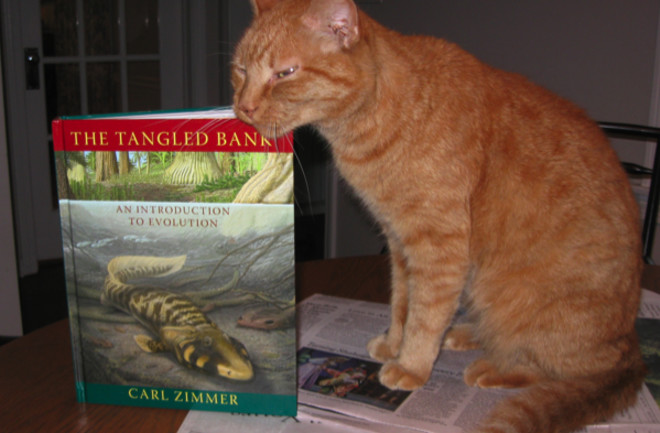
The stork UPS man pitched a box through the front door this morning. Inside was an advance copy of my new book, The Tangled Bank: An Introduction to Evolution. The paternal photographer in me took over, and now I have to show off my snaps. Above is a picture that I like for two reasons. One is the way it shows off Carl Buell’s lovely (and crowd-critiqued) cover. The other is the way it illustrates the book’s far-less-than-a-doorstop mass, which is all too typical for textbooks these days. In fact, the book’s smaller than Tino, our far-less-than-a-doorstop cat.

Continue reading “Pictures From A Proud Book Papa”

Just a technical note, with shades of exasperation: After my web site got hacked earlier a couple months back, I changed ISP’s and spent a lot of time bringing it up to date. Now I’ve discovered that it’s not working again, because of some mysterious error. I’m getting help with it, but it may take a few days for everything to get back in place.

Originally published August 24, 2009. Copyright 2009 Carl Zimmer.