Everything is connected. And when I say everything, I include you, dear reader, and the tapeworms of Madagascar. They carry a hidden history of our entire species.

I’m sure we’d all prefer that there was no such connection. Tapeworm are not just gross, but they are pretty much the polar opposite of the human existence. They have no brain. They have no eyes. They lack mouths and guts, having turned their body inside out, absorbing food through its surface. Most of their hideously long body is made up of segments, each of which contains its own supply of both eggs and sperm. To reproduce, the tapeworm fertilizes its eggs, either with its own sperm or another tapeworm’s, and then sheds its segments. Once out of the body, those segments can crawl around on the ground on their own.
Continue reading “Why Madagascar’s Tapeworms Matter–To You”

The New York Times, April 26, 2010

Link

Edward M. Marcotte is looking for drugs that can kill tumors by stopping blood vessel growth, and he and his colleagues at the University of Texas at Austin recently found some good targets — five human genes that are essential for that growth. Now they’re hunting for drugs that can stop those genes from working. Strangely, though, Dr. Marcotte did not discover the new genes in the human genome, nor in lab mice or even fruit flies. He and his colleagues found the genes in yeast.

“On the face of it, it’s just crazy,” Dr. Marcotte said. After all, these single-cell fungi don’t make blood vessels. They don’t even make blood. In yeast, it turns out, these five genes work together on a completely unrelated task: fixing cell walls.

Continue reading “The Search for Genes Leads to Unexpected Places”

Alex, a graduate student studying human biology and evolution, writes, “As an undergraduate at I was fortunate enough to study On Growth and Form by D’Arcy Thompson. His synthesis of mathematics, classics and biology was an inspiration to me, and drove me to pursue science as a career. Though I am now studying to be a paleoanthropologist, my tattoo of an (idealized) ammonite fossil is a reminder to me of the material and mathematical processes behind all living things. Plus extinct cephalopods are more aesthetically appealing than hominin skulls.”

Click here to go to the full Science Tattoo Emporium.

Originally published April 25, 2010. Copyright 2010 Carl Zimmer.

Here’s a lecture Steven Johnson gave last night at Columbia about the future of text. (Steven has a transcript here.) Lo and behold, that degree in semiotics twenty years ago makes a lot of sense now!

[Update: I embedded the video here this morning, but it starts on its own, and sometimes it shows a lecture by someone else. Future of journalism, indeed–c’mon, Columbia! Here’s the place where I think you can find the video.]

Originally published April 23, 2010. Copyright 2010 Carl Zimmer.

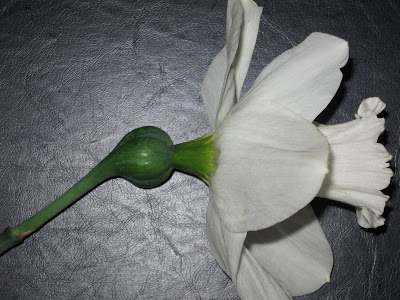
I didn’t know Oliver Wendell Holmes thought the odors of boxwoods “carry us out of time into the abysses of the unbeginning past.” I didn’t know that the necks of daffodils bulge when their ova are fertilized. At least, I didn’t know such things before my wife Grace started to garden, and then to chronicle her experiences in  a new blog . I think it’s delightful, but don’t take my spousal word for it–check it out!

Originally published April 22, 2010. Copyright 2010 Carl Zimmer.