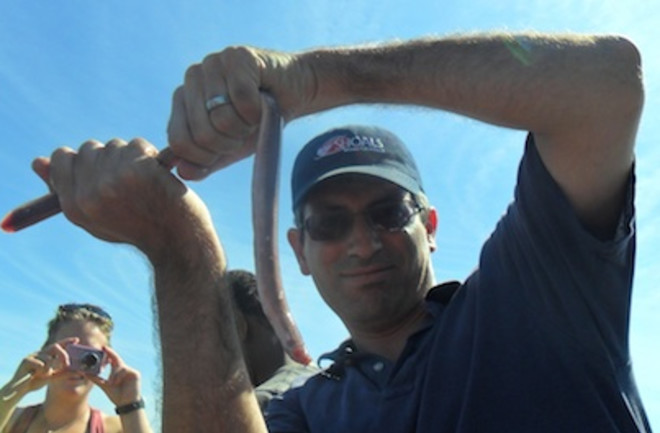
I’ve been waiting a long time to see a hagfish in person. Last year I took a class miles out to sea, hauled up traps from 300 feet, and came up with nothing but mud. Today, however, we discovered not just one hagfish–but fifty. Buckets full of squirming jawless beasts that seemed to slither straight out of the Cambrian Period. Their slime is more like a jelly made of glass–a marvelous thing. I am here to declare that a day with fifty hagfish is a good day.

(For more, read “Secrets of the Slime Hag” (pdf)” in Scientific American by Frederic Martini)

[Image courtesy of Charlotte Zimmer, age 9]

Originally published August 11, 2010. Copyright 2010 Carl Zimmer.

This week I’m on the Island of Science Writing. Today we wandered rocky coves with Tufts University biologist Julie Ellis, an expert on gulls. She showed us how to catch and band juvenile herring gulls–and how to recognize the matted remains of juvenile herring gulls coughed up by their great black-backed gulls predators. Life here is pretty, and yet not so pretty. But always interesting for writing about.

Originally published August 10, 2010. Copyright 2010 Carl Zimmer.

Brian Switek , one of the junior members of the science-blogging-whippersnapper brigade, has written a detailed look back at the saga of Darwinius, the primate fossil that held Mayor Bloomberg captive at a press conference. It was just published in the journal Evolution: Education and Outreach and is free for the taking. Switek has kind things to say about the impact of the Loom’s coverage of the subject, although I’m pretty sure this blog–and the many others that hopped on this crazy story–won’t stop this sort of fiasco from happening again. All we can do is help set the record straight.

Originally published August 5, 2010. Copyright 2010 Carl Zimmer.

It’s becoming increasingly clear that global warming may trigger many changes beyond the obvious change in temperature. Earlier this year I wrote about how rising carbon dioxide is driving down the pH of the oceans, with some potentially devastating consequences. Today in Yale Environment 360 I look at a potential change that’s also starting to get scientists very worried: a drop in the oxygen dissolved in the world’s oceans. Check it out.

[Image: Christopher Sebela on Flickr]

Originally published August 5, 2010. Copyright 2010 Carl Zimmer.