The Zimmer clan is preparing for some renovations to the house, which means boxing up all my books. We’ve got a particularly tall stack of copies of my first book, At the Water’s Edge: Fish with Fingers, Whales With Legs, and How Life Came Ashore and Went Back to the Sea. We’d rather sell these books than pack them. And so, from today till Friday, I’ll be offering autographed copies at my Amazon store for the low, low price of $5. (Imagine me shouting all this, Crazy-Eddie style.)

If you’re not familiar with the book, you can check out its carlzimmer.com page or check out thisreview in Times Higher Education, in which the reviewer writes, “It is wicked, I know, but I have the habit of turning over the corners of pages whenever I chance upon something unexpectedly interesting, exciting or informative. Zimmer’s At the Water’s Edge quickly became the most dog-eared book on my shelves.”

Continue reading “We’d rather sell than pack!”

The New York Times, May 16, 2011

Link

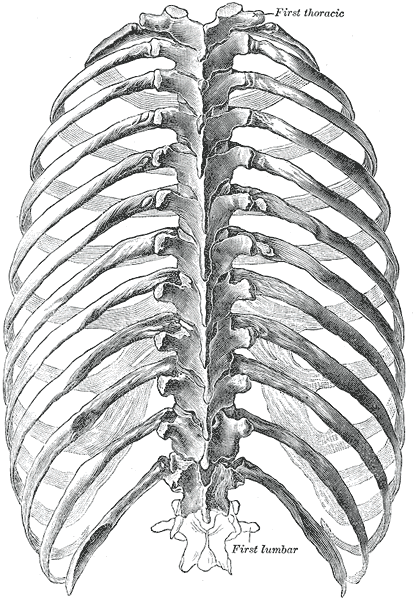
DURHAM, N.C.—The sign on the door at the renovated tobacco warehouse reads “Physcient.” Inside are a few rooms that, depending on where you look, seem like an artist’s studio, a machine shop or a natural history museum. A lathe stands next to a drill press; along other walls are vises, huge enamel-red C-clamps, microscopes and plywood frames covered in electronics. But there are also reed-woven sculptures of insects called water boatmen hanging on the walls, along with glass-fronted boxes holding preserved flying dragon lizards. Casts of human rib bones are scattered on tables. A huge cast of a fearsome pair of fish jaws rests on a row of books.

Continue reading “Turning to Biomechanics to Build a Kinder, Gentler Rib Spreader”

Each Friday this month, I’m having a conversation about viruses to mark the publication of my new book A Planet of Viruses. Last week, I talked to virologist Ian Lipkin about the search for new viruses and their potential to alter our behavior. Today, I’m delighted to talk with Richard Preston, the author of the Hot Zone and other books on viruses. He and I discuss the fate of smallpox. The worst viral killer in the history of civilization is now wiped off the face of the Earth, except for some laboratory stocks. Preston and I take on the question of whether we should now annihilate it. Check it out.

Originally published May 13, 2011. Copyright 2011 Carl Zimmer.

Long, long ago–actually, in 2006–I wrote an article for the New York Times about a very strange relative of today’s alligators and crocodiles. Effigia, which lived 210 million years ago, did not slouch around inTriassic swamps. Instead, it stood on two big hind legs, holding its front legs–arms, really–aloft. It looked an awful lot like a bipedal dinosaur, despite the fact that the ancestors of dinosaurs and crocodiles split off 250 million years ago.

Continue reading “What’s so special about dinosaurs?”

It’s time to pay another visit to Cordyceps, the fungus that turns its hosts into spore-sprouting zombies.

The fungus, which can be found in many parts of the tropics, penetrates an insect’s exoskeleton and then work its way into its host’s body. At first the ant seems normal to the human eye, but eventually it makes its way to a leaf, where it clamps down with its mandibles. Cordyceps then sprouts out of the ant’s body, lashing it to the leaf’s underside, and producing a long stalk tipped with spores. The spores can then shower down on unfortunate insects below.

Continue reading “More eldritch ant horror!”