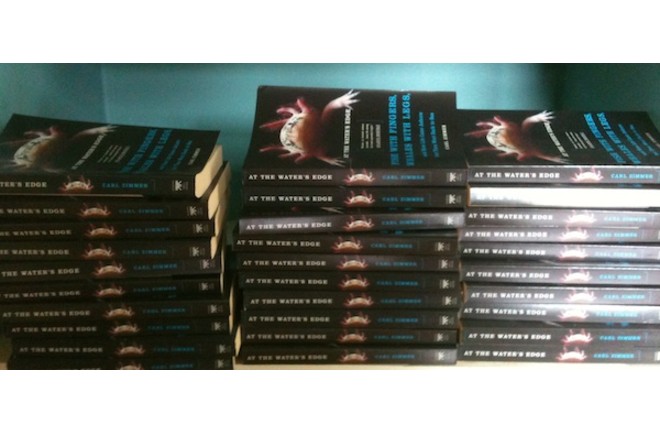
Having just returned from a ten-day family reunion road trip, I discovered a surprise in our attic: several extra boxes of my first book, At the Water’s Edge. You may recall that I put a bunch of autographed copies of this book on sale in my Amazon store to clear them out in advance of my office getting ripped apart. Well, the ripping-apart is now just days away, and now I have eighty more copies to get out of this house. (This photo shows just a selection.)

So–help! For the next week, you can get an autographed copy for six bucks. Order it here.

Continue reading “Fourth-of-July Secrets-in-the-Attic Book Sale!”

It’s been very gratifying to listen to the conversation that’s been triggered by my essay in this Sunday’s New York Times on scientific self-correction. Here, for example, is an essay on the nature of errors in science by physicist Marcelo Gleiser at National Public Radio. Cognitive scientist Jon Brock muses on how to get null results published.

Continue reading “De-discovery round-up (plus a correction)”

Some people get a thrill from getting their genome sequenced and poring through the details of their genes. I’m a bit off-kilter, I guess, because I’m more curious about the genomes of the things living in my belly button. And let me tell you: it’s a jungle in there.

I first became curious about my navel in January. I was in Durham, North Carolina, to attend a meeting, and as I walked out of a conference room I noticed a cluster of people in the lobby handing out swabs. They were asking volunteers to stick the swabs in their belly button for the sake of science. Our bodies are covered with microbes, and scientists are discovering weirdly complex patterns to their biodiversity. From fingers to elbows to chin to forehead, different regions of our skin are dominated by different combinations of species. But the bellybutton remained terra incognita.

Continue reading “Discovering my microbiome: “You, my friend, are a wonderland””

In the late 1800s, prominent astronomers declared that Mars was criss-crossed by canals–evidence, they declared, of an advanced civilization. But in the early 1900s, astronomers gazed through more powerful telescopes and discovered that the canals were mirages.

The astronomer Percival Lowell, who had become the leading champion of the canals, scoffed at the new findings. Hedeclared that the criticism came “solely from those who without experience find it hard to believe or from lack of suitable conditions find it impossible to see.”

Continue reading “Dediscovery: My new essay for a new section of the New York Times”

The New York Times, June 25, 2011

Link

One of the great strengths of science is that it can fix its own mistakes. “There are many hypotheses in science which are wrong,” the astrophysicist Carl Sagan once said. “That’s perfectly all right: it’s the aperture to finding out what’s right. Science is a self-correcting process.”

If only it were that simple. Scientists can certainly point with pride to many self-corrections, but science is not like an iPhone; it does not instantly auto-correct. As a series of controversies over the past few months have demonstrated, science fixes its mistakes more slowly, more fitfully and with more difficulty than Sagan’s words would suggest. Science runs forward better than it does backward.

Continue reading “It’s Science, but Not Necessarily Right”