The New York Times, December 3, 2011

Link

Imagine a scientist gently swabs your left nostril with a Q-tip and finds that your nose contains hundreds of species of bacteria. That in itself is no surprise; each of us is home to some 100 trillion microbes. But then she makes an interesting discovery: in your nose is a previously unknown species that produces a powerful new antibiotic. Her university licenses it to a pharmaceutical company; it hits the market and earns hundreds of millions of dollars. Do you deserve a cut of the profits?
Continue reading “Our Microbiomes, Ourselves” →

It’s been a busy week for Science Ink!

1. Science Ink was on TV. The Daily Planet, a Canadian science news show on the Discovery Channel, interviewed me about my favorite tattoos.

2.The Irish Times put Science Ink on top of its list of science books for holiday gifts. (As did MSNBC and io9.)

3. Der Spiegel  takes a look.

4. The Toronto Star has a whole package on Science Ink in Saturday’s issue: A Q&A with yours truly, an article by Megan Ogilvie about Toronto-area scientists with tattoos, and a slide show of their tattoos. (I was amazed that there were lots of tattoos I had never seen before!)

5. Just a reminder to folks in Boston: I will be giving a lecture at the Harvard Museum of Natural History on Tuesday, 12/13 at 6 pm. The lecture is free and open to the public. (The parking is free too!) Details are here.

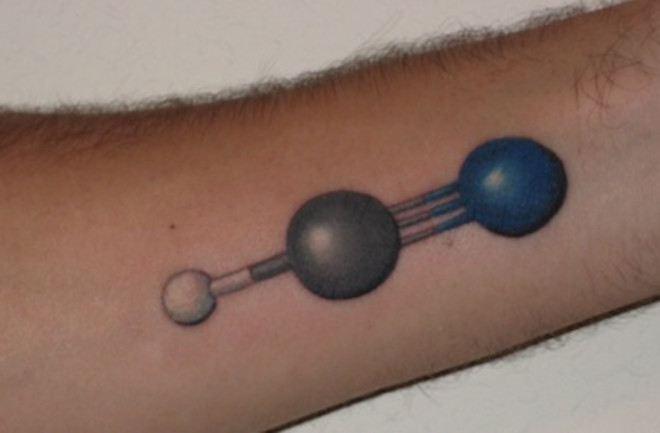
[This tattoo of cyanide is from David Lighthart.]

Originally published December 2, 2011. Copyright 2011 Carl Zimmer.

Today marks the one-year anniversary of the Arsenic Life Affair. On December 2, 2010, NASA-funded scientists announced that they had discovered a microbe in Mono Lake that broke the rules of biology. They claimed it could build DNA from arsenic rather than phosphorus. It was a sensational claim, and it was greeted by a spectacular backlash.

Alan Boyle takes a close look at arsenic life on its first birthday over at MSNBC. Other scientists have yet to report whether they can replicate the results or not (the bet of many experts is on not). Meanwhile, other researchers are studying its biology, sequencing its genome, and otherwise investigating it as they would any new microbe. It seems as if the arsenic life affair is morphing into regular science. Which may be about as good of an ending as one could hope.

Continue reading “Happy Birthday, #arseniclife” →

When it comes to viruses, we humans like to pretend we know much more than we really do. It’s understandable. The influenza virus, for example, has only ten genes. It is just a shell that delivers genes and proteins into a host cell, where it hacks the biochemistry to manufacture more viruses. It seems like such an easy biological problem to solve.

Yet the flu and other viruses hide a complexity which virologists have only partly uncovered. The idea that someone could intentionally design a super-lethal virus from scratch–as plausible as it may seem–is, for now, a delusion.

Continue reading “Making viruses the natural way” →

In January, I’ll be conducting the 2012 edition of my science writing workshop for graduate students. The workshop is hosted by the Yale Ecology and Evolutionary Biology Department. It’s a short introduction to the craft of bringing science to the world, tailored for science graduate students. People who attend are typically interested in making science writing part of their work as scientists, or are even thinking about making it their career. Students from other institutions can contact the EEB department to get permission to register.

The syllabus and information about registering are on the workshop web site.

Originally published November 30, 2011. Copyright 2011 Carl Zimmer.