Earlier this year in National Geographic, I wrote about how feathers evolved long before flight. This timing naturally raises the question, how did feathered dinosaurs take to the air? My article was accompanied by a picture from the University of Montana lab of Ken Dial, who argues that before dinosaurs flew, they flapped their wings to help them travel up and down inclines. While not all experts accept Dial’s hypothesis, it has the undeniable strength that he can gather evidence for it in living birds, rather than just inferring behavior from fossils alone.
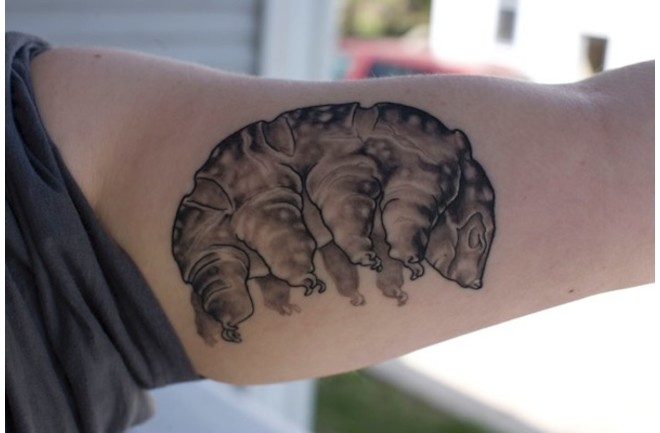
We’re getting close to the publication of Science Ink (official date, November 1), and some very fun things are approaching. The wonderful National Public Radio show Studio 360, hosted by Kurt Anderson, decided to talk to some of the scientists featured in the book–about their science, about their tattoos, and about the nature of openness. It will be on their next episode, which starts airing around the country this weekend. (Here’s the segment page on their web site.)
And you can listen to it right here–
More announcements to come!
Originally published October 21, 2011. Copyright 2011 Carl Zimmer.
Ten years ago this month, a team of University of Oxford scientists published a description of a family who struggled with words. By comparing their DNA, the scientists zeroed in for the first time on a gene associated with language, dubbed FOXP2. In my newest column in Discover, I look back at what scientists have learned over the past decade about how FOXP2 works, and what it tells us–or leaves us wondering–about how language evolved. Check it out.
Originally published October 17, 2011. Copyright 2011 Carl Zimmer.
Discover, October 17, 2011
It is a shame that grammar leaves no fossils behind. Few things have been more important to our evolutionary history than language. Because our ancestors could talk to each other, they became a powerfully cooperative species. In modern society we are so submerged in words–spoken, written, signed, and texted–that they seem inseparable from human identity. And yet we cannot excavate some fossil from an Ethiopian hillside, point to a bone, and declare, “This is where language began.”
Lacking hard evidence, scholars of the past speculated broadly about the origin of language.
Continue reading “The Language Fossils Buried in Every Cell of Your Body”
Nuria Gonzalez-Montalban , a post-doctoral researcher at the University of Maryland, writes:
My name is Nuria and I am a biologist working with prions. Since the structure of prions has not been described yet (at least completely), I would not want to tattoo a possibly-wrong prion. Instead, I chose a T4 virus since part of my undergrad and PhD were related to E.coli and T4 bacteriophages.
Given that bacteriophages are the most common living thing on Earth, it’s good that at least one person on Earth has it on his arm.
You can see the rest of the Science Tattoo Emporium here or in my book, Science Ink: Tattoos of the Science Obsessed.
Originally published October 14, 2011. Copyright 2011 Carl Zimmer.