Radiolab has a new episode available for your auditory pleasure. The theme of this episode is “Patient Zero.” Hosts Jad Abumrad and Robert Krulwich trace diseases and ideas back to their places of origin. I help tell the story of the origin of HIV along with David Quammen (who’s got a book  coming out soon on animal diseases) and some of the pioneering scientists who have figured out how viruses spill over from animals to us.)

Check it out!

Originally published November 15, 2011. Copyright 2011 Carl Zimmer.

Discover, November 15, 2011

Link

Neuroscientists these days regularly make spectacular discoveries about how the brain gets sick. They know much more today about brain cancer, Alzheimer’s disease, Parkinson’s disease, and a host of other neurological disorders than they did just a few years ago. And from such discoveries come all sorts of encouraging possibilities for treating or even curing these diseases. If only we could break down some rogue protein or bind a drug to a troublesome receptor, it seems as if all would be well. There’s just one little hitch: Even if scientists invented the perfect cure, they probably couldn’t get it into the brain to do its work.

Continue reading “Maybe You Do Need a Hole in Your Head—to Let the Medicine In”

When the Society for Neuroscience gets together for their annual meeting each year, a city of scientists suddenly forms for a week. This year’s meeting has drawn 31,000 people to the Washington DC Convention Center. The subjects of their presentations range from brain scans of memories to the molecular details of disorders such as Parkinson’s and autism. This morning, a scientist named Svante Paabo delivered a talk. Its subject might make you think that he had stumbled into the wrong conference altogether. He delivered a lecture about Neanderthals.

Yet Paabo did not speak to an empty room. He stood before thousands of researchers in the main hall. His face was projected onto a dozen giant screens, as if he were opening for the Rolling Stones. When Paabo was done, the audience released a surging crest of applause. One neuroscientist I know, who was sitting somewhere in that huge room, sent me a one-word email as Paabo finished: “Amazing.”

Continue reading “Neanderthal Neuroscience”

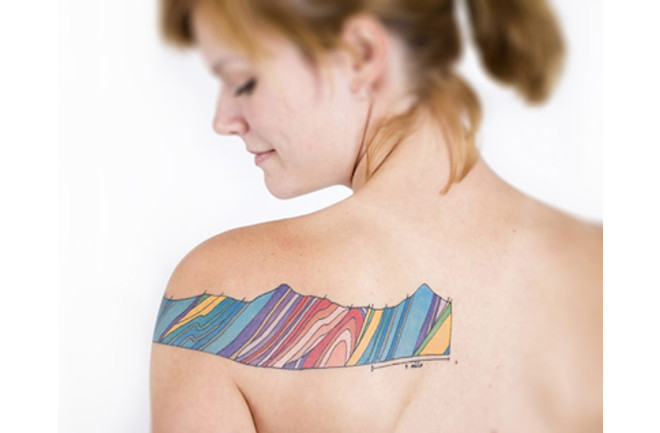
Two pieces of Science Ink related news:

1. The New York Times put together a slide show from the book (including several tattoos that I haven’t published on the blog). Check it out.

2. New Scientist offered this kind review (sub’n required):

“When Carl Zimmer asked on his blog whether tattoos were common among scientists, he unwittingly became the curator of a set of incredible images, and of intimate stories that reveal a love affair with science. We are familiar with the idea that people tattoo themselves with a name or symbol representing the great love in their life. Those who love science are no different. Zimmer was inundated with responses.

Continue reading “#scienceink update: The New York Times does a slide show, and New Scientist approves”

Spencer Debenport, a plant pathologist at Ohio State University, sports a tattoo of a tardigrade, a microscopic animal known as the water bear. “I have always loved microscopic critters, and there is none other as intriguing as the tardigrade,” he writes. “The fact that they are so hardy, yet still that odd mixture of ugly/cute drew me to them and the more I read up on them, the more I wanted one permanently on me. I am also a mycologist, so whenever I look at lichens I get to see loads of these little guys roaming around.”

Continue reading “The Toughest Bear in the Universe #scienceink”