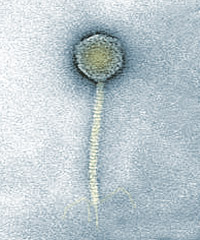
Charles Darwin recognized that natural selection can make eyes sharper, muscles stronger, and fur thicker. But evolution does more than just improve what’s already there. It also gives rise to entirely new things—like eyes and muscles and fur. To study how new things evolve, biologists usually have to rely on ancient clues left behind for hundreds of millions of years. But in a study published today, scientists at Michigan State University show that it’s possible to watch something new evolve in front of their eyes, in just a couple weeks.

The scientists were studying a virus, which evolved a new way of invading cells. As a result, their research not only sheds light on a fundamental question about evolution. It also suggests that it may worryingly easy for viruses such as influenza to turn into new epidemics. Check it out.

[Image of lambda virus: AJC1 on Flickr via Creative Commons]

Originally published January 26, 2012. Copyright 2012 Carl Zimmer.

A fair number of scientists like to get a tattoo to celebrate their research. Ryan Carney, a biologist at Brown University has taken the practice one step further. He’s gotten a tattoo that shows the key finding of a paper he and his colleagues have just published today. They studied a fossil feather from Archaeopteryx, the iconic bird (or almost-bird). They conclude it looked just like this tattoo.

Carney collaborated on the research with a team of scientists who have developed a method to reconstruct colors from fossils. One source of colors in animals is a cellular structure called a melanosome. Depending on the size, shape, and spacing of melanosomes, they can produce a range of hues. It turns out that melanosomes are incredibly rugged, sometimes enduring for millions of years.

Continue reading “Archaeopteryx: The Embargoed Tattoo”

This Tuesday I’ll be giving a talk at the New York Academy of Sciences about Science Ink–complete with live tattooed scientists!

Here are some of the details

When: Tuesday, January 24, 2012, 7:00 PM – 8:30 PM. (A reception will follow.)
Where: The New York Academy of Sciences
7 World Trade Center
250 Greenwich Street, 40th floor
New York, NY 10007-2157
212.298.8600

Get $10 dollars off full-price tickets by using the promo code ZIMMER. Register here: http://www.nyas.org/scienceink

See you there!

Originally published January 20, 2012. Copyright 2012 Carl Zimmer.

In yesterday’s New York Times, I wrote about a new paper in which scientists report the evolution of single-celled yeast into multicellular snowflake-like “bodies.” Most (but not all) of the experts I contacted for the story had high praise for the study. (It also won an award when it was presented as a talk over the summer at the Society for the Study of Evolution.) Once the story appeared, however, some scientists took to Twitter to express their skepticism. As much as I like Twitter, this is one of the situations where it fails. You can’t have a conversation about genetics, lab strains versus wild types, etc., in 140 character chunks. At least not very satisfying ones.

Continue reading “Evolving Bodies: A Storify follow-up”

The New York Times, January 16, 2012

Link

Our ancestors were single-celled microbes for about three billion years before they evolved bodies. But in a laboratory at the University of Minnesota, brewer’s yeast cells can evolve primitive bodies in about two weeks.

The transition to multicellular life has long intrigued evolutionary biologists. The cells in our bodies have evolved to cooperate with exquisite precision. The human body has more than 200 types of cells, each dedicated to a different job. And a vast majority of the 100 trillion cells in our bodies sacrifice their own long-term legacy: Only eggs and sperm have a chance to survive our own death.

Continue reading “Yeast Experiment Hints at a Faster Evolution From Single Cells”