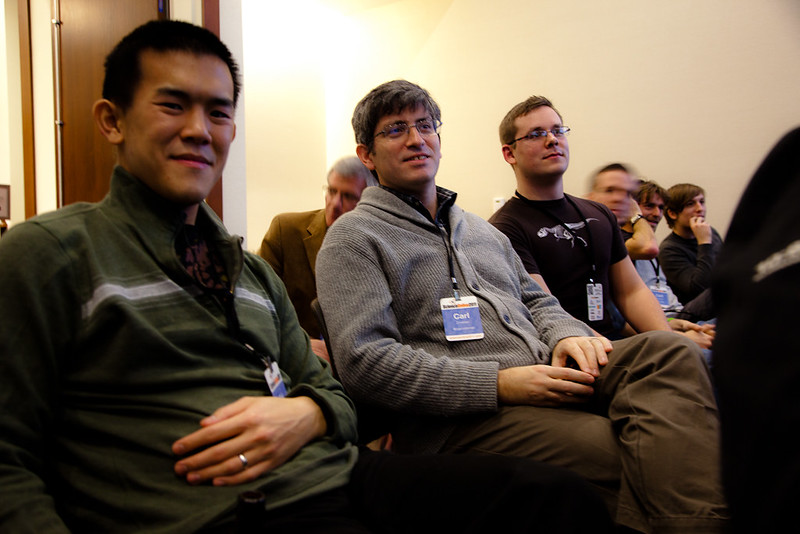
I’m heading south to give a series of talks about everything from evolution to science tattoos, the future of journalism, and the mutant bird flu saga. Most of these talks are open to the public. Here’s the rundown, with the public talks noted:
This post was originally published in “Download the Universe,” a multi-author blog about science ebooks edited by Carl Zimmer.
April 25, 2012
On April 4, the Pew Research Center’s released an extensive report on the country’s e-reading habits as part of its Internet and American Life project. It is, as is oftentimes the case with Pew reports, quite interesting and exceedingly bland. (You can find an introduction to the Pew report here; the full report is also available online or as a free download.)
If there’s ever excuse to publish an optical illusion as cool as the “Rotating Snakes,” I’ll take it. This illusion was invented in 2003 by Akiyoshi Kitaoka of Ritsumeikan University in Japan, and ever since, Kitaoka and other scientists have been trying to figure out why it works. A new paper by Stephen Macknik at the Barrow Neurological Institute in Phoenix may have the answer.
As you’ll notice, the circles seem to rotate in response to where you look at the illusion. So Macknik and his colleagues tracked the movement of people’s eyes as they gazed at two of these wheels on a computer screen. Their subjects kept a finger pressed on a button, lifting it whenever they seemed to see the wheels move.
This post was originally published in “Download the Universe,” a multi-author blog about science ebooks edited by Carl Zimmer.
April 24, 2012
On April 4, the Pew Research Center’s released an extensive report on the country’s e-reading habits as part of its Internet and American Life project. It is, as is oftentimes the case with Pew reports, quite interesting and exceedingly bland. (You can find an introduction to the Pew report here; the full report is also available online or as a free download.)
This post was originally published in “Download the Universe,” a multi-author blog about science ebooks edited by Carl Zimmer.
April 23, 2012
On April 4, the Pew Research Center’s released an extensive report on the country’s e-reading habits as part of its Internet and American Life project. It is, as is oftentimes the case with Pew reports, quite interesting and exceedingly bland. (You can find an introduction to the Pew report here; the full report is also available online or as a free download.)