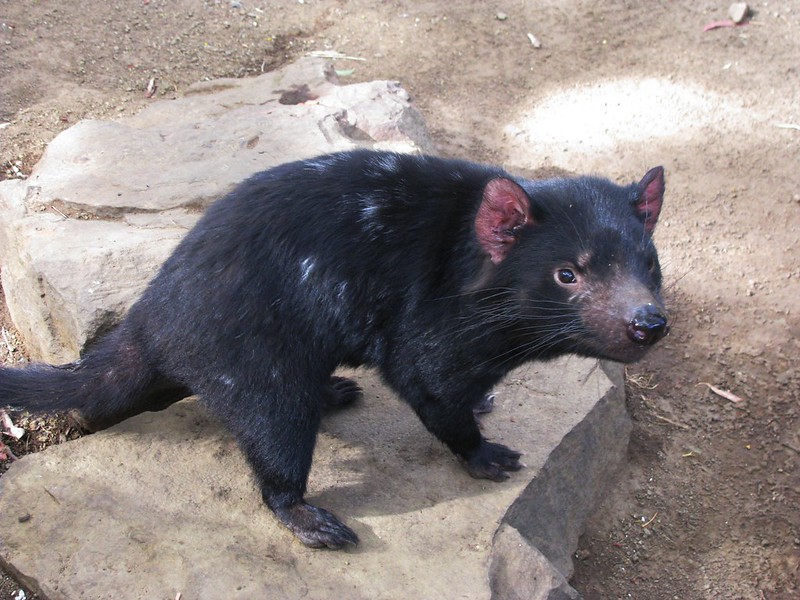
In thirty years, Tasmanian devils may be gone from the face of the Earth. If they do vanish, they will be wiped out in a fashion unlike any other endangered species we know of. The marsupials have developed a cancer that acts like a parasite, jumping from host to host.

In today’s New York Times, I take a look at what scientists are now learning about this strange contagious tumor, and the desperate measures they’re going to in order to protect the species from its unique devastation.

[Image: Arthur Chapman, Flickr/Creative Commons]

Originally published January 22, 2013. Copyright 2013 Carl Zimmer.
The New York Times, January 21, 2013

Link

In November, a team of biologists journeyed to Maria Island, three miles off the Australian island state of Tasmania, taking with them 15 plastic cylinders. They loaded the cylinders into S.U.V.’s, drove them to an abandoned farm and scattered them in the fields.

Before long 15 Tasmanian devils emerged from the containers, becoming the first ever to inhabit the island.

“All indications are that they’re doing very well,” Phil Wise, a government wildlife biologist who leads the project, said of the devils — fierce-looking, doglike marsupials that have become an endangered species on the much larger island for which they are named.

Continue reading “Raising Devils in Seclusion”

Twenty eight years ago, the first coyotes arrived in Newfoundland. They had come a long way.

Up until the 1800s, coyotes lived mostly in the southwestern United States, and in low numbers in the Midwest. To the east and north, wolves shut them out of their forests. But when farmers and trappers exterminated wolves in much of North America, the coyotes began to expand their range. By the 1970s, they had reached the far corners of New England. In the winter of 1985, there were reports in Newfoundland of wolf-like animals traveling across the ice to the Port au Port Peninsula. In 1987, a car hit one of the animals, and it was confirmed to be a coyote pup. The coyotes had come about as far east as they possibly could.

Continue reading “Snow Coyotes and Spirit Bears”

Meredith Palmer writes, “I am currently working on Guam studying the invasive Brown Tree Snake. I graduated with my B.A. in Zoology in 2011 and have spent the last year or so in Africa studying large mammals, in the Caribbean examining guppy evolution, and in Canada digging up dinosaurs. And now I find myself in the Pacific! The plan, however, is to attend graduate school next fall. Although I majored in zoology, I always had an interested in paleontology born out of cold, rainy childhood summers spent cracking shale in New England with my geologist parents. Dicranurus is one of my favorite trilobite species, and the design is modeled after scientific plates in the publications of Barrande, a Boehmian paleontologist from the 1800s.”

Barrande’s beautiful illustrations are posted on the Smithsonian’s web site. For more on the glorious vanished trilobites, visit A Guide to the Order of the Trilobites.

You can see the rest of the Science Tattoo Emporium here and in Science Ink: Tattoos of the Science Obsessed.

Originally published January 20, 2013. Copyright 2013 Carl Zimmer.

This week the FDA announced that they were approving a new kin

Originally published January 17, 2013. Copyright 2013 Carl Zimmer.

d of flu vaccine. Nestled in the articles was an odd fact: unlike traditional flu vaccines, the new kind, called Flublok, is produced by the cells of insects.

This is the kind of detail that you might skim over without giving it a thought. If you did pause to ponder, you might be puzzled: how could insects possibly make a vaccine against viruses that infect humans? The answer may surprise you. To make vaccines, scientists are tapping into a battle between viruses and insects that’s raging in forests and fields and backyards all around us. It’s an important lesson in how to find new ideas in biotechnology: first, leave biologists free to explore the weirdest corners of nature they can find.

Continue reading “Viruses That Make Zombies and Vaccines”