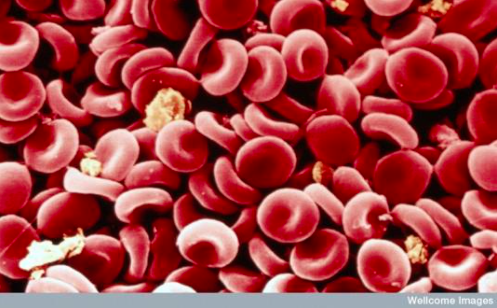
E.M.UNIT, ROYAL FREE HOSPITAL SCHOOL OF MEDICINE/WELLCOME TRUST PHOTO LIBRARY/CREATIVE COMMONS

A simple question deserves a simple answer. How many cells are in your body?

Unfortunately, your cells can’t fill out census forms, so they can’t tell you themselves. And while it’s easy enough to look through a microscope and count off certain types of cells, this method isn’t practical either. Some types of cells are easy to spot, while others–such as tangled neurons–weave themselves up into obscurity. Even if you could count ten cells each second, it would take you tens of thousands of years to finish counting. Plus, there would be certain logistical problems you’d encounter along the way to counting all the cells in your body–for example, chopping your own body up into tiny patches for microscopic viewing.

For now, the best we can hope for is a study published recenty in Annals of Human Biology, entitled, with admirable clarity, “An Estimation of the Number of Cells in the Human Body.”

Continue reading “How Many Cells Are In Your Body?”

PHOTO BY BRIDGIT COILA VIA CREATIVE COMMONS

Genetic testing for individual disorders was once the brave new world, but now it’s a familiar routine of having a baby. But what about looking over a baby’s entire genome? As the price for sequencing DNA crashes, it’s becoming a real possibility. At Slate, I write a new study in which the genomes of 240 babies will be sequenced, and researchers will see whether how that avalanche of data affects their medical care. Check it out.

Continue reading “Genomes From Birth: My New Piece for Slate”

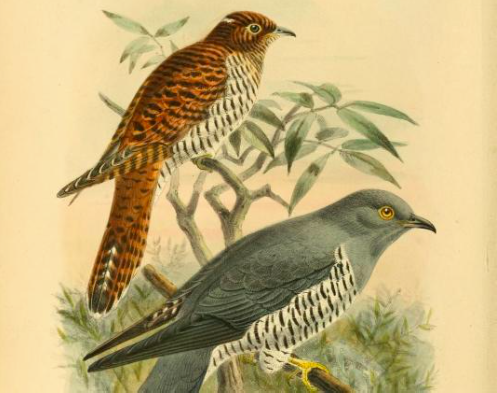
COMMON CUCKOO. BIODIVERSITY HERITAGE LIBRARY, VIA CREATIVE COMMONS

Mimicry is one of the eeriest feats of evolution. An insect doesn’t know what a leaf looks like, and yet some species have evolved to resemble leaves down to the finest details. Their mimicry emerges from the ruthless cycle of evolution. The ancestors of leaf insects produced lots of genetic variation, thanks to mutations and mating. Some of that variation affected how they looked. Birds have been feasting on the insects for millions of years, and their victims have tended to be the easiest ones for them to see against their leafy background. The insects that were harder tended to survive and reproduce. Over time, evolution acted like a sculptor, turning an ordinary insect body into a shape that blended in with the surrounding leaves.

But the mimicry of leaf insects, as cool as it may be, is simple stuff compared to what’s evolved in other species. Continue reading “Nature’s Double Con”

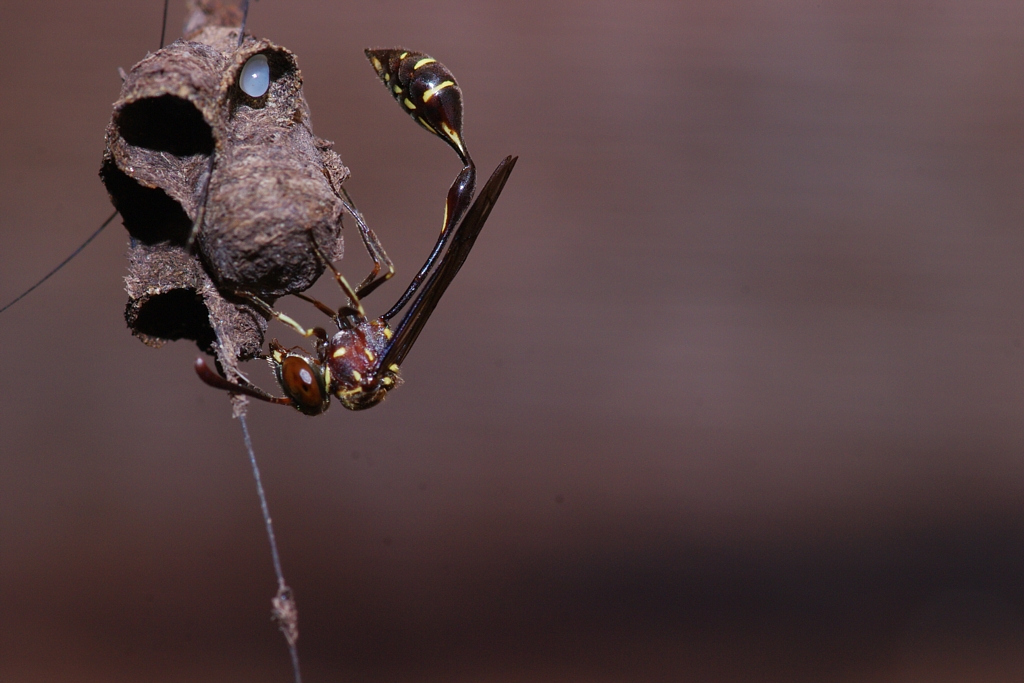
Mud dauber wasp. Photo by Jaxo S via Creative Commons: http://flic.kr/p/9SHhE9

Growing up on a small farm, I was able to get to know the insects that lived on the property pretty well. Some I liked, and some I hated. I hated the mud dauber wasps that built organ-pipe shaped cavities for their eggs on the side of our chicken coop and always seemed poised to sting me. On the other hand, I became fond of ants; they hypnotized me with their affable industry, hauling food back to their nests or moving larvae to a new home.

In my “Matter” column today for the New York Times, I take a look at a new study that has produced an evolutionary tree of ants and their relatives. Continue reading “On the Origin of Ants–From Wasps”

The New York Times, October 17, 2013

Link

How should we judge the success of an animal? Philip S. Ward, a biologist at the University of California, Davis, offers what could be called the Picnic Test. “Have a picnic anywhere in the world,” he suggests. “Who would pick up the crumbs?”

Unless you happen to lay down your picnic blanket in Greenland, Antarctica, or a few remote islands in the Pacific, the answer will be ants. Ants have spread to just about every corner of earth’s dry land, colonizing virtually every imaginable ecosystem. By one rough estimate, there are 10,000 trillion ants on earth at any moment. In one study in a Brazilian rain forest, scientists discovered that the total mass of the ants that lived there was about four times greater than that of all the mammals, reptiles and amphibians combined.

Continue reading “Key to Ants’ Evolution May Have Started With a Wasp”