The New York Times, March 3, 2014

Link

Siberia fills the heads of scientists with dreams of resurrection. For millions of years, its tundra has gradually turned to permafrost, entombing animals and other organisms in ice. Some of their remains are exquisitely well preserved — so well, in fact, that some scientists have nibbled on the meat of woolly mammoths.

Some researchers even hope to find viable mammoth cells that they can use to clone the animals back from extinction. And in 2012, Russian scientists reported coaxing a seed buried in the permafrost for 32,000 years to sprout into a flower.
Continue reading “Out of Siberian Ice, a Virus Revived”

Scientific American, March 2014

Link

The Nuvvuagittuq greenstone belt doesn’t look like a battlefield. It lies in peaceful, roadless isolation along the northeastern edge of Hudson Bay in Canada, more than 20 miles from Inukjuak, the nearest human settlement. From the shoreline, the open ground swells into low hills, some covered by lichens, some scraped bare by Ice Age glaciers. The exposed rocks are beautiful in their stretched and folded complexity. Some are gray and black, shot through with light veins. Others are pinkish, sprinkled with garnets. For most of the year the only visitors here are caribou and mosquitoes.

But this tranquil site is indeed a battleground—a scientific one. For almost a decade rival teams of geologists have traveled to Inukjuak, where they have loaded canoes with camping gear and laboratory equipment and trekked along the coast of the bay to the belt itself. Their goal: to prove just how old the rocks are. One team, headed by University of Colorado geologist Stephen J. Mojzsis, is certain that the age is 3.8 billion years. That is pretty ancient, though not record setting.

Continue reading “The Oldest Rocks on Earth”

National Geographic, February 28, 2014

Link

Van Wedeen strokes his half-gray beard and leans toward his computer screen, scrolling through a cascade of files. We’re sitting in a windowless library, surrounded by speckled boxes of old letters, curling issues of scientific journals, and an old slide projector that no one has gotten around to throwing out.

“It’ll take me a moment to locate your brain,” he says.

On a hard drive Wedeen has stored hundreds of brains—exquisitely detailed 3-D images from monkeys, rats, and humans, including me. Wedeen has offered to take me on a journey through my own head.

Continue reading “Secrets of the Brain”

PHOTO BY RAM GAL, BEN-GURION UNIVERSITY

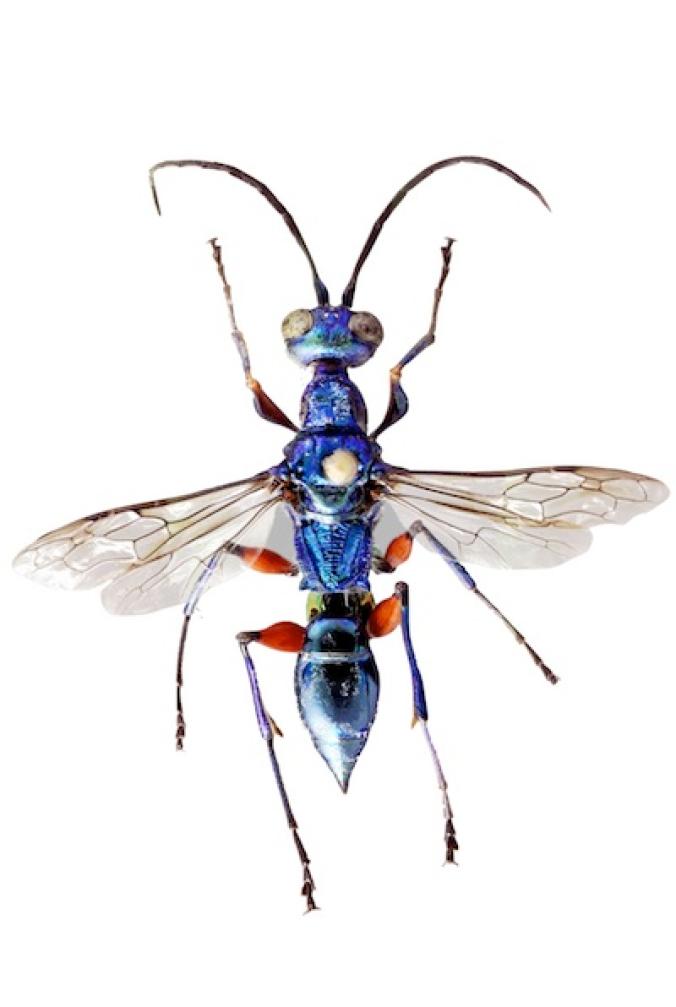
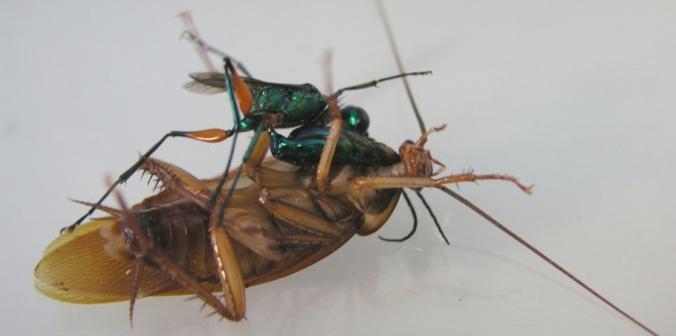
If you’ve never met the emerald jewel wasp, let me introduce you to my little friend. The wasp (Ampulex compressa) lives the first stage of its life as a parasite, growing inside the body of a living cockroach. 

Ampulex compressa. Photo by K. Seltmann, via Creative Commons. Link: http://www.morphbank.net/?id=102143

That’s absorbingly horrific on its own, but how it gets into the cockroach in the first place is an especially gruesome delight. Its mother has to play neurosurgeon. Continue reading “Crawling Through The Brain Without Getting Lost”

The New York Times, February 27, 2014

Link

Forcing male flies into monogamy has a startling effect: After a few dozen generations, the flies become worse at learning.

This discovery, published on Wednesday in the Proceedings of the Royal Society, isn’t a biological excuse for men who have strayed from their significant other. Instead, it’s a tantalizing clue about why intelligence evolved.

The new study was carried out by Brian Hollis and Tadeusz J. Kawecki, biologists at the University of Lausanne in Switzerland. They investigated a fly species called Drosophila melanogaster that normally has a very un-monogamous way of life.

Continue reading “Stupider With Monogamy”