One Month To Go!
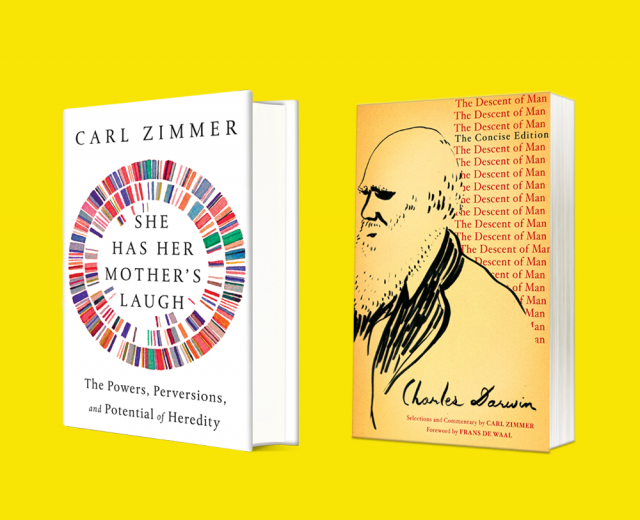
The official publication date for She Has Her Mother’s Laugh is May 29. My fingernails are already nubs. As any author will tell you, these days pre-orders make a huge difference to the launch of a book. I’m deeply proud of this book and hope you’ll find the subject as fascinating as I did writing about it. Please consider pre-ordering a copy. And tell all your friends who have ever wondered about heredity to consider doing so, too. Ordering early will help me bring the book to the attention of even more potential readers. Many thanks!

Big Stories in Little Things
I’ve written another Facebook post about science books. Today, it’s Jonathan Weiner’s The Beak of the Finch, one of the books that showed me as a young science writer how it’s done. Nearly a quarter of a century later, the science has moved on, but the book remains a classic.

Photo: Melissa IlardoThe Evolution of Human Divers?
In southeast Asia, a group of extraordinary divers have plunged deep underwater to fish for centuries. A new study suggests they’ve adapted to their way of life, evolving larger spleens to deliver more oxygen. I wrote about the research last week for my column in the New York Times. (While the researchers I contacted for the story were impressed with the research, some scientists took to Twitter for a little critical post-publication peer review–see population geneticist Matthew Hahn and physiologist Michael Joyner.)

Photo: Frans Lanting
Hot Chimps
Oe a trip to Africa in 1995, I spent a few days in a cloud forest in Rwanda. There were chimpanzees around me, but I never got to see them. Only the seasoned experts at the field station could navigate the dense vegetation and catch glimpses of the apes. They became my personal icons of chimpanzees–creatures of the cool, wet canopy. But chimpanzees are more flexible than that. Some in Senegal live on a savanna that can hit 110 degrees. For my column this week, I wrote about a long-term study of these very different chimpanzees–and the hints they offer us about how our own ancestors abandoned forests for the open plains.
“The Code”–all of it
All three episodes of Retro Report’s series on the past and future of genetics are now online.
You can watch them here.
Talks
May 2, 2018 “From Ebola to Dinosaurs to 23andMe: Writing about the Science of Life” Columbia School of Journalism
May 3, 2018 MIT, Knight Science Journalism seminar
May 17, 2018 “Exploring the Complexity and Controversy of Heredity” Keynote Lecture, Bio-IT World, Boston
May 21, 2018 “Biotechnology and Its Future Impact on Greater Boston” (panel discussion) Boston Athenaeum
May 30, 2018 Harvard Book Store
May 31, 2018 RJ Julia Bookstore, Madison CT
June 6, 2018 Kramerbooks, Washington DC
June 19, 2018 Commonwealth Club Silicon Valley, Palo Alto CA
June 20, 2018 Denver Museum of Nature and Science (details to come)
September 20, 2018 University of Bath (UK), Evolution in the 21st Century (details to come)
October 19, 2018 CSICon, Las Vegas
October 25, 2018 Mount Holyoke College (details to come)
You can find information about my other books here. You can also follow me on Twitter, Facebook, Goodreads. LinkedIn, and Google+. If someone forwarded this email to you, you can subscribe to it here.
Best wishes, Carl
Originally published April 28, 2018. Copyright 2018 Carl Zimmer.