What Seals Can Tell Us About Our Dreams
Sleep is one of my enduring fascinations. I’ve revisited the research on sleep from time to time in my work at the New York Times. In my first piece, back in 2005, I looked at research on how different animals sleep, and how it can help shed light on the mystery of why we need to sleep at all. Two years later, I looked more closely at the strange sleeping habits of birds–especially ones that can fly for thousands of miles.
When did sleep evolve? Well, the chemistry that makes it possible may have started hundreds of millions of years ago, as our single-celled ancestors rose and fell through the ocean over the course of each day. More recently, wehumans may have evolved better sleep when we came down from the trees and began sleeping on the ground. The molecular study of sleep has revealed important clues too; here’s a piece I wrote about research that suggests wesleep in order to clear out the brain’s metabolic garbage that piles up each day.
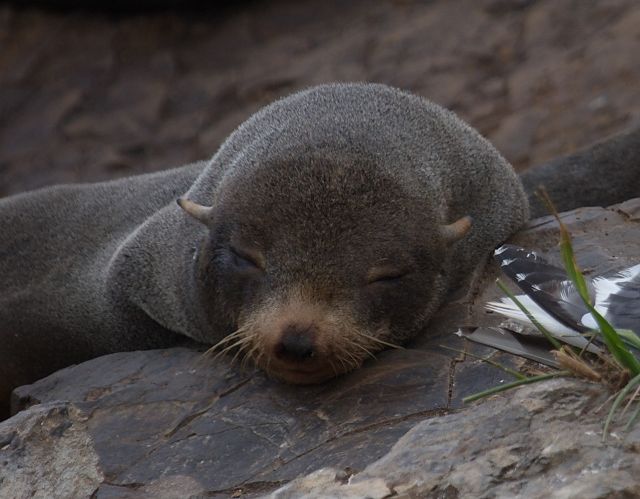
For last week’s column, I came back to the question of sleep once more. In particular, the strange bouts of activity known as REM sleep. A new study on seals reveals that they experience REM sleep like no other animal ever studied before. And those patterns point to an intriguing function that REM sleep may carry out: brain shivers.
CRISPR, Cancer, and the Stock Market
In She Has Her Mother’s Laugh, I explore the discovery of the gene-editing technology CRISPR and consider its possible use to fix hereditary diseases. Yesterday, several companies seeking to make medicine out of CRISPR. They all fell at 11 am. The reason? Two studies were published in Nature Medicine pointing to how cells respond to having their DNA altered. Basically, they don’t like it. Does that mean CRISPR raises the risk of cancer? Or does it mean that Wall Street has a hard time waiting for science to do its thing?I take a look at the situation for my column today in the New York Times.

More Book News
1. Ed Yong and I had a great time at a packed house at Kramerbooks in Washington DC on Wednesday, talking about She Has Her Mother’s Laugh. Thanks to @MezidaSaeed for the photographic evidence!
2. I talked to Terry Gross on Fresh Air
3. Historian Nathaniel Comfort reviewed She Has Her Mother’s Laugh in the new issue of the Atlantic: “Magisterial…In Zimmer’s pages, we discover a world minutely threaded with myriad streams of heredity flowing in all directions, in variegated patterns and different registers.”
4. Writer Hamilton Cain reviews the book for the Minneapolis Star Tribune: “A leading contender as the most outstanding nonfiction work of the year”
5. Jerry Coyne reviewed my book for the Washington Post, praising “its combination of accuracy, journalistic clarity and scientific authority….If the science doesn’t matter to you now, it will soon.” Coyne also recommended the book for summer reading on his blog, Why Evolution Is True.
6. I stopped by WNPR’s new studio in New Haven to talk for an hour about heredity.
7. Next week I’m heading off for the western leg of my book tour. First stop, Palo Alto. Hope to see you there! (Details below.)
Upcoming TalksJune 19, 2018
Commonwealth Club Silicon Valley, Palo Alto CA
June 20, 2018 Denver Museum of Nature and Science
June 21-24, 2018 Aspen Ideas Festival
September 20, 2018 University of Bath (UK), Evolution in the 21st Century
October 17, 2018 Colorado State University: Murray Honors Visiting Scholar Lecture (details to come)
October 19, 2018 CSICon, Las Vegas
October 25, 2018 Mount Holyoke College (details to come)
November 7, 2018 University of Pennsylvania, Philadelphia (details to come)
November 14, 2018 Stevens Institute of Technology, Hoboken, NJ (details to come)
You can find information and ordering links for my other books here. You can also follow me on Twitter, Facebook, Goodreads, and LinkedIn. If someone forwarded this email to you, you can subscribe to it here.
Best wishes, Carl
Originally published June 12, 2018. Copyright 2018 Carl Zimmer.