Chris Daub writes:

I don’t know if you are still collecting these, but I wanted to send you a pic of my recent tattoo of a Von Karman vortex street. This is a (reasonably) faithful representation of an image from an actual experiment to produce this phenomenon, from the book An Album of Fluid Motion (hope they don’t sue me!).

I’ve always thought it was a beautiful pattern, and I’m fascinated with how it appears in such diverse contexts in a large range of space and time scales. I work in molecular simulation of fluids, so I don’t quite study Von Karman vortices, but this kind of fluid dynamics is at least tangentially related to my field.

You can see the rest of the Science Tattoo Emporium here or in my book, Science Ink: Tattoos of the Science Obsessed.

Originally published August 5, 2012. Copyright 2012 Carl Zimmer.
If you or someone you know is a student at Yale, check out the class I’m teaching this fall. It’s called Writing about Science and the Environment (cross-listed as EVST 215 and ENGL 459). You can find out about it on the Yale Online Course Information site, where I’ve just posted the syllabus.

Originally published August 1, 2012. Copyright 2012 Carl Zimmer.

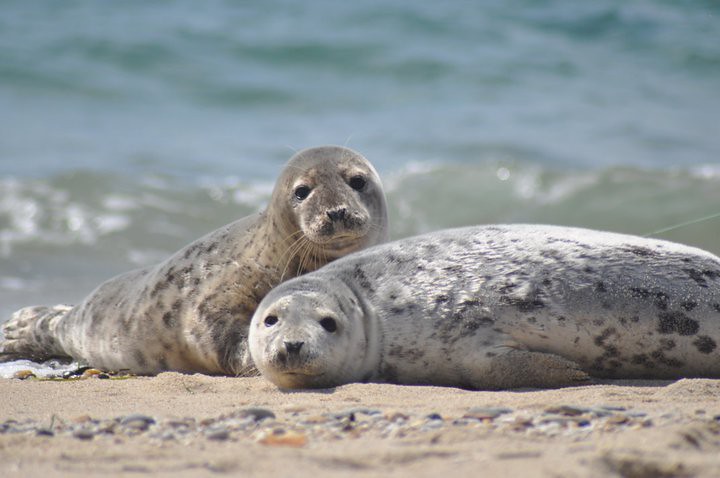
Last September, harbor seal pups in Massachusetts and New Hampshire started to die in droves. In today’s New York Times, I write about what killed them: a new influenza strain that evolved from shorebirds to seals, possibly as recently as last summer. While controversy swirls around scientists experimentally nudging flu viruses across the evolutionary between birds and mammals, Nature has been doing some experiments of its own. Check it out.

PS–The paper is in press at mBio. I’ll post a direct link when there is one, which should be this morning. Update: Here’s the paper.

[Photo of harbor seals in Nantucket by U. S. Fish and Wildlife Service – Northeast Region]

Originally published July 31, 2012. Copyright 2012 Carl Zimmer.

Next month, my first co-authored book is coming out. Evolution: Making Sense of Life is a textbook for biology majors, and my co-author is Doug Emlen, a professor at the University of Montana. I’ve heard many tales of disastrous collaborations between scientists and science writers, and so I don’t enter into them lightly. But working with Emlen has been a delight. No matter how many times we’ve had to rewrite a chapter, he threw himself into the work as if he was cannonballing into a swimming pool. And yet somehow Emlen was advancing his own research in evolutionary biology at the same time, quietly chugging away on some remarkable experiments. And today–just a week after we shipped our book off to the printers–Emlen’s latest, most intriguing paper has just come out in the journal Science.

Continue reading “Why You Can’t Fake A Good Horn”