Yesterday I had the pleasure of delivering the Flexner Discovery Lecture at Vanderbilt to a packed room. My talk was entitled, “When Science Goes Wrong and Ways To Fix It.” I talked about some of the struggles the science community is facing with poorly replicated research and misconduct, and how we science journalists can make things worse by seizing on research to make huge claims. The video (complete with slides) is now online. Check it out.

Continue reading “When Science Goes Wrong And Ways to Fix It: Video of My Lecture At Vanderbilt”

A MOUNTAINEER TAKES A WELL-NEEDED BREATH OF OXYGEN FROM HIS MASK NEAR THE TOP OF MOUNT EVEREST. SOURCE: http://ucrtoday.ucr.edu/3827/oh-oxygen

One of the most important things that makes Earth special is the abundant oxygen in its atmosphere. How it got that way is a surprisingly complicated story that’s just coming to light. It’s a story I delve into for this week’s “Matter” column in the New York Times. Check it out.

Continue reading “Breathe in the Mystery: My New York Times Column on Oxygen”

IS THIS THE LAST THING THAT PARASITE-INFECTED RODENTS SEE? PHOTO BY JULIE FALK VIA CREATIVE COMMONS

Life is rough for parasites. Say you’re a tapeworm that only lives in the gut of one species of shark. You start out as an egg inside an adult tapeworm. Your parent releases you and a bunch of other eggs from its body, and its shark host shoots you out of its own body. Now you float in the vast ocean, stretching out on all sides. You are not made for the free-living world. If you don’t get into another host, you will never reach adulthood. Not just any host, but a fish. And not just any fish, but one species of shark. Chances are good, in other words, that you’ll die.

The miserable odds for individual parasites can potentially drive the evolution of something remarkable: the ability of parasites to manipulate their hosts. By controlling their hosts, the parasites can raise their odds of surviving and reproducing.

Continue reading “The Great Puppet-Master Debate”

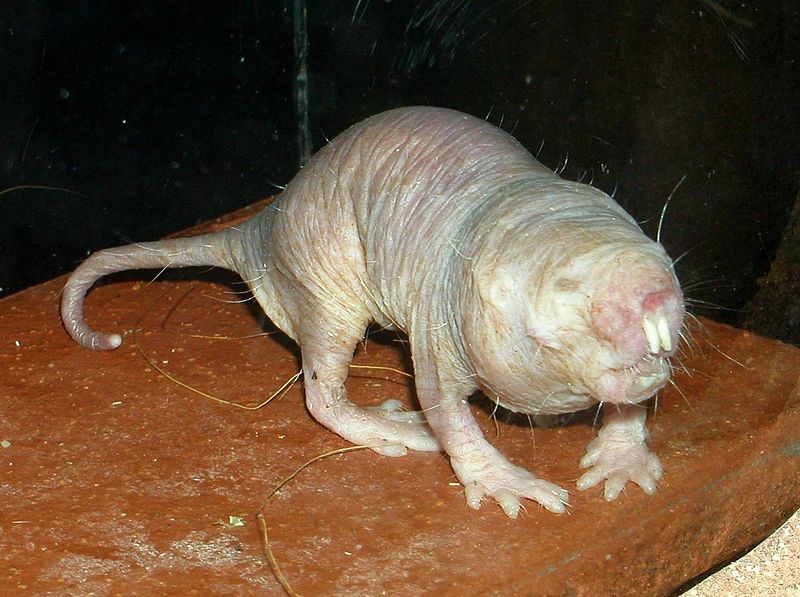
Via Wikipedia: http://commons.wikimedia.org/wiki/File:Nacktmull.jpg

In June I wrote about the amazing longevity of naked mole rats. These rodents can live for thirty years, whereas their mice cousins can only live two years. One secret to their longevity may be the fact that they’ve never been documented with cancer. As I wrote back in June,  scientists at the University of Rochester found  a gooey protein in the tissues of the rodents that prevents cells from multiplying out of control.

But naked mole rats do more than just fight cancer. In addition to avoiding tumors, they also resist the overall decline seen in other aging mammals. A new study from the same Rochester team may reveal how they ward off aging: they’re very careful about making proteins.

Continue reading “When You’re A Naked Mole Rat, Why Stop At One Weapon Against Aging?”

PHOTO BY STEVE SAUS, VIA CREATIVE COMMONS

On Monday I was at a meeting at MIT. When it broke up in the afternoon, I breathed a sigh of relief. The purpose of the meeting was to bring together lots of people who share science in one way or another–in museums, on Facebook, at street fairs, in books, and so on–and have them talk about what they saw in the future. Thankfully, I got to the end of the day without anyone stopping to say, “Now, we really need to talk about how blogging is going to change the landscape. Carl, maybe you could stand up and explain how blogs work?”

I had reason to dread this, because I’ve experienced variations of it over the years. People were wondering whether blogs were here to stay long after they had infiltrated the entire body of journalism. But it seems that, at long last, no one even thinks of blogs as something new and strange. And it felt particularly satisfying to me to go unbothered on that point this particular week. Because today marks the tenth anniversary of The Loom.

Continue reading “Ten Years!”