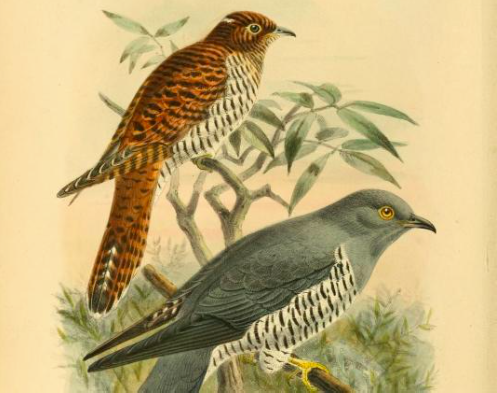
COMMON CUCKOO. BIODIVERSITY HERITAGE LIBRARY, VIA CREATIVE COMMONS

Mimicry is one of the eeriest feats of evolution. An insect doesn’t know what a leaf looks like, and yet some species have evolved to resemble leaves down to the finest details. Their mimicry emerges from the ruthless cycle of evolution. The ancestors of leaf insects produced lots of genetic variation, thanks to mutations and mating. Some of that variation affected how they looked. Birds have been feasting on the insects for millions of years, and their victims have tended to be the easiest ones for them to see against their leafy background. The insects that were harder tended to survive and reproduce. Over time, evolution acted like a sculptor, turning an ordinary insect body into a shape that blended in with the surrounding leaves.

But the mimicry of leaf insects, as cool as it may be, is simple stuff compared to what’s evolved in other species. Continue reading “Nature’s Double Con”
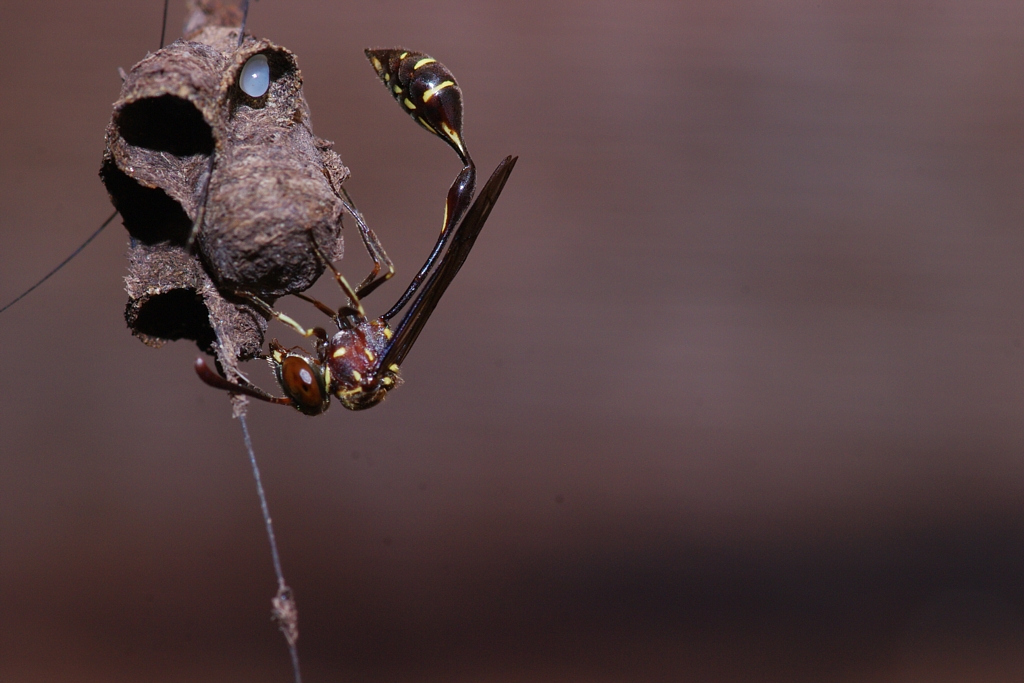
Mud dauber wasp. Photo by Jaxo S via Creative Commons: http://flic.kr/p/9SHhE9

Growing up on a small farm, I was able to get to know the insects that lived on the property pretty well. Some I liked, and some I hated. I hated the mud dauber wasps that built organ-pipe shaped cavities for their eggs on the side of our chicken coop and always seemed poised to sting me. On the other hand, I became fond of ants; they hypnotized me with their affable industry, hauling food back to their nests or moving larvae to a new home.

In my “Matter” column today for the New York Times, I take a look at a new study that has produced an evolutionary tree of ants and their relatives. Continue reading “On the Origin of Ants–From Wasps”

Last month I blogged about Retro Report, a new outfit that produces deeply researched videos that bring history up to date. I found today’s report especially interesting, as it explores some of the same material I wrote about inmy piece for National Geographic about de-extinction in April. The Retro Report team looks at the sensation caused back in 1997 by Dolly, the cloned sheep. All of the scare-mongering about armies of zombie clones has blotted out people’s understanding of cloning’s actual history, its disappointments, and its big impacts today.

Continue reading “What Dolly Wrought: Retro Report Looks at Cloning”

Earlier this year, I wrote about a simple way to probe the mind of a dog: point to something and see if the dog understands your intent. Dogs generally do, and that’s remarkable. Many species, including our closest ape relatives, do a bad job of interpreting a pointed hand.This week in my “Matter” column for the New York Times, I look at a new study that suggests we add another species to the elite list of animals that understand pointing: elephants. Do elephants learn the meaning of pointing from humans? Or do these social behemoths use their trunks to point things out to each other?

Continue reading “Pointing At the Minds of Elephants: My Column This Week For the New York Times”

The color of an animal can determine whether it lives or dies. If it’s easily spotted by predators, it may well become a meal. Hidden nicely against its background, an animal can escape its enemies for another day.

The particular colors on an animals are determined partly by the genes its gets from its parents. That means that genes that hide animals can spread thanks to natural selection, leading to the evolution of exquisite camouflage. But that’s not to say that the animal kingdom has settled on a perfect, fixed palette. You can find mismatched individuals. Over the course of generations, a whole population can flicker between mismatched and well-matched.

Continue reading “Evolution in Color: From Peppered Moths to Walking Sticks”