In case snakes weren’t enough of a fright-fest for you this Halloween, here’s a video that I narrated for National Geographic about one of nature’s spookier creatures. (One of many, as I explain in Parasite Rex.)
Category: Blog
In case snakes weren’t enough of a fright-fest for you this Halloween, here’s a video that I narrated for National Geographic about one of nature’s spookier creatures. (One of many, as I explain in Parasite Rex.)

One of the strangest episodes in the history of biology occurred in 1953. A physicist named George Gamow, who is best known for his work on the Big Bang, sat down and read a new paper by two biologists named James Watson and Francis Crick. They reported that DNA is arranged as a double helix. Gamow then wondered how DNA encodes proteins. DNA used four “letters” in its genes, while proteins are built from a chemical alphabet of twenty amino acids. He realized that the question turned life into a problem in cryptography. Continue reading “The Code of Life: My New Feature for Nautilus Magazine”
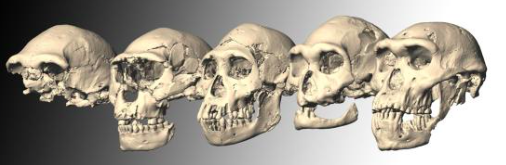
Last week, scientists published a study of five 1.8 million-year-old hominid fossils. They may reveal profound lessons about a crucial chapter in our evolution: how our ancestors changed from bipedal apes to a more human-like lineage–in other words, the emergence of our genus, Homo. So what name do we give these skulls? What species do they belong to? It’s no simple matter naming our hominid ancestors, and that difficulty tells us something intriguing about their biology. And that’s the subject of my “Matter” column this week in the New York Times. Check it out.
Continue reading “Naming Our Ancestors: My New Column for the New York Times”
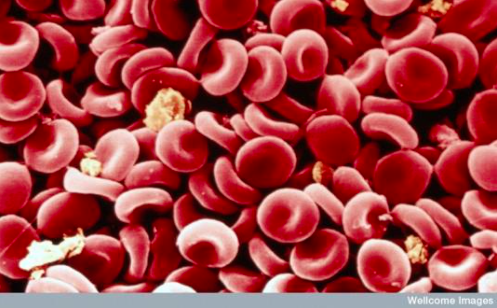
A simple question deserves a simple answer. How many cells are in your body?
Unfortunately, your cells can’t fill out census forms, so they can’t tell you themselves. And while it’s easy enough to look through a microscope and count off certain types of cells, this method isn’t practical either. Some types of cells are easy to spot, while others–such as tangled neurons–weave themselves up into obscurity. Even if you could count ten cells each second, it would take you tens of thousands of years to finish counting. Plus, there would be certain logistical problems you’d encounter along the way to counting all the cells in your body–for example, chopping your own body up into tiny patches for microscopic viewing.
For now, the best we can hope for is a study published recenty in Annals of Human Biology, entitled, with admirable clarity, “An Estimation of the Number of Cells in the Human Body.”

Genetic testing for individual disorders was once the brave new world, but now it’s a familiar routine of having a baby. But what about looking over a baby’s entire genome? As the price for sequencing DNA crashes, it’s becoming a real possibility. At Slate, I write a new study in which the genomes of 240 babies will be sequenced, and researchers will see whether how that avalanche of data affects their medical care. Check it out.
Continue reading “Genomes From Birth: My New Piece for Slate”