Less than two percent of the human genome is made up of protein-coding genes. Fifty years ago, scientists launched an expedition of the other 98 percent. It has been a slow march for much of that time, but in recent years the pace has picked up, thanks to advances such as new ways to sequence DNA.
Category: Blog
My newest column for Discover is about that strangest of the senses, smell. An odor can be an overwhelming experience, and yet it’s often impossible to put that experience into words. In fact, we’re terrible at naming smells, despite being exquisitely sensitive to the differences between them. I take a look at some recent research that may bring us closer to resolving this paradox, with the invention of the first yardstick for the nose–a simple measurement of odor molecules that reveals a lot about how pleasant or vile we find them. Not only might it help us understand our own noses, but it may even let us build electronic noses to sniff for things we don’t want to stick our own noses in. Check it out.
Originally published May 18, 2010. Copyright 2010 Carl Zimmer.
Elizabeth Kolbert writes this morning about the Anthropocene, a new geological epoch marked by the dominance of our species. It may be hard to precisely mark its beginning, but here’s why I think it will be easy for geologists 10 million years in the future to pinpoint layers of Anthropocene rocks.
Originally published May 17, 2010. Copyright 2010 Carl Zimmer.
David writes, “My tattoos each mark–although in rather oblique and coded ways–life events, or at least transitions that are important to me (several are a rebus for my 1999 dissertation in post-structuralist political philosophy). This 10th tattoo, of Hemoglobin A, perhaps requires less decoding than many. Over the last couple years, I have had the opportunity to work with some amazing people, on the computer science side of things, who have built the world’s fastest supercomputer–called Anton, after so-called ‘father of microbiology’ Antonie van Leeuwenhoek–which is highly specialized for computing molecular dynamics. As a gesture to this opportunity, I commemorate it with a molecular rendering (of the PDB chemical 2W6V, using VMD and the NewCartoon rendering style) of the sort that the chemist who do the actual MD often look at. Of course, Hemoglobin is a well-known molecule to laypersons, and it is one that is easy enough to give a metaphorical or mimetic sense to; the molecule is inscribed above my heart, whose function is largely to pump around oxygen-carrying Hemoglobin (hence giving my body life, vitality, energy, etc).”
Click here to go to the full Science Tattoo Emporium.
Originally published May 16, 2010. Copyright 2010 Carl Zimmer.
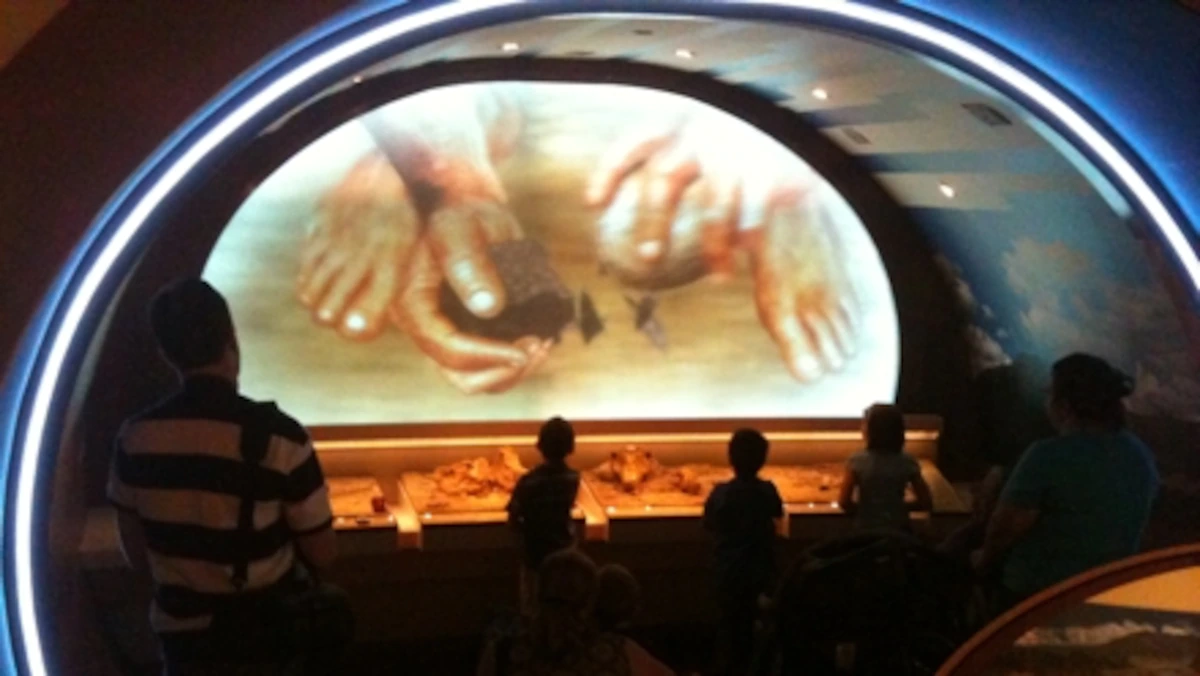
Having come down to Washington this weekend to give a talk, I knew I had to get over to the Smithsonian’s new Hall of Human Origins. The Smithsonian’s Briana Pobiner was kind enough to take me around and tell me about what went into its creation. I suppose I could pretend to be a professional museum reviewer and present a lengthy description of the hall, tell you what I liked, give the obligatory “But nothing is ever perfect,” indulge in some musings on the state of museumology, and on and on.
Continue reading “Smithsonian Hall of Human Origins: Just Go”