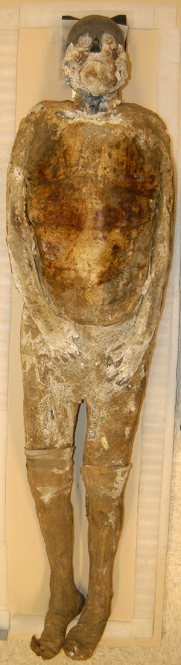
To make soap, you must mix grease or fat with lye or some other alkaline substance. Sometimes, however, the stuff makes itself. If, for example, water laced with alkaline soil seeps into a coffin, it can transform a human body into soap. (This cadaver soap is known as grave wax or adipocere.) Here’s a picture of a “soapman” in the collection of National Museum of Natural History in Washington, just posted in the Smithsonian’s “Snapshot Series.” It belongs to a man who was buried in Philadelphia around 1800. His body was discovered in 1875 during an excavation to build a train depot. This particular example of grave wax is kept under lock and key in the museum’s “Dry Environment room,” so this is the closest you’ll get to seeing it. But if you want to see grave wax in person, be sure to get to the Mutter Museum in Philadelphia, which keeps its eerie “Soap Lady” under glass.

Originally published January 4, 2011. Copyright 2011 Carl Zimmer.

Hurrah! Choice, the leading magazine for academic book reviews, has namedThe Tangled Bank: An Introduction to Evolution one of the outstanding academic titles of 2010. Here’s a line from the announcement: “These outstanding works have been selected for their excellence in scholarship and presentation, the significance of their contribution to the field, and their value as important–often the first–treatment of their subject.”

Originally published January 3, 2011. Copyright 2011 Carl Zimmer.

Last year, I gave the keynote lecture at the first annual Northeast Conference on Science and Skepticism in New York. It was a nerve-wracking experience, given that James Randi was originally slated to give the keynote, but was too ill at the time to attend. So I brought some of my favorite head-slapping tales of the dysfunctional relationship between science and the media, from global warming disinformation to so-called missing links. My goals for the talk were laughter, tears, and a glimmer of hope.

Continue reading “Missing Links, George Will, and Other Train Wrecks: My Keynote Talk at NECSS”