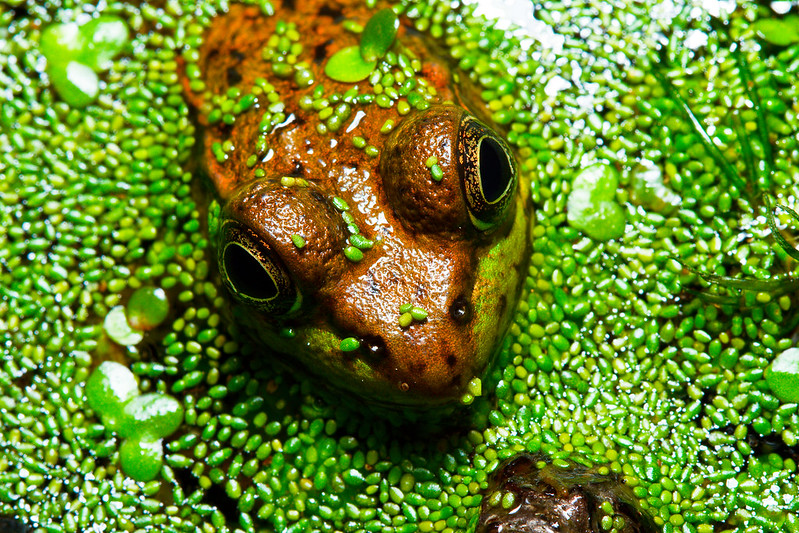
I sat down recently with ecologist David Skelly to talk about the strange things happening to frogs these days. A few years back, scientists found evidence suggesting that pesticides were causing sexual deformities in frogs that lived near farms. Now Skelly is finding that the situation is actually a lot more dire for frogs in suburbs and cities. Over at Yale Environment 360, you can read our Q & A about what sort of chemical cocktail may be making eggs grow in the testes of male frogs–and what it may all mean for us fellow vertebrates.

[Image: Telemudcat at Flickr, Creative Commons License]

Originally published February 21, 2011. Copyright 2011 Carl Zimmer.

Here’s the video of the lecture I gave last week at Stony Brook University, which was the basis of my recent blog post. I’ve uploaded the slides as a pdf here. (You can read the slides online or download them by going to the File drop-down menu.) I’m not sure what the ideal combination of video and slides would be…if anyone has any suggestions, let me know.

[Update–the video url got switched around. This should work now…]

Originally published February 17, 2011. Copyright 2011 Carl Zimmer.

Nicholas Wade reports today in the New York Times on a tantalizing study that may offer some insight into the evolution of aging, the subject of my recent Darwin Day lecture. An extended family in Ecuador carries a mutation that seems to leave them completely free of cancer and diabetes. The mutation affects a growth hormone receptor on their cells, so that the cells produce low levels of a growth factor. As I mentioned in my lecture, scientists have studied animals with this same mutation, and they can live to amazingly old ages–the life span of C. elegans worms doubles, for example.

Continue reading “Escaping youth’s double-bind?”

In my National Geographic article last year on carnivorous plants, I mentioned one particularly swift killer, the bladderwort. This aquatic plant grows little suction traps that can be triggered by passing animals. In a new paper in the Proceedings of the Royal Society, French researchers take the closest look yet at these ultrafast killers. They find that the door to the traps buckles like a popped bubble of chewing gum–but can then almost immediately swing back shut. Along with the new study on jumping fleas I wrote about last week, this is evidence of how far we’re just starting to explore the world of quick biology.

Science News has a nice write-up, and here is an excellent YouTube video provided by a co-author of the study, Philippe Marmottant, a physicist at Joseph Fourier University in Grenoble, France–complete with computer simulation, rubber-cap demos, and groovy soundtrack.

Originally published February 16, 2011. Copyright 2011 Carl Zimmer.