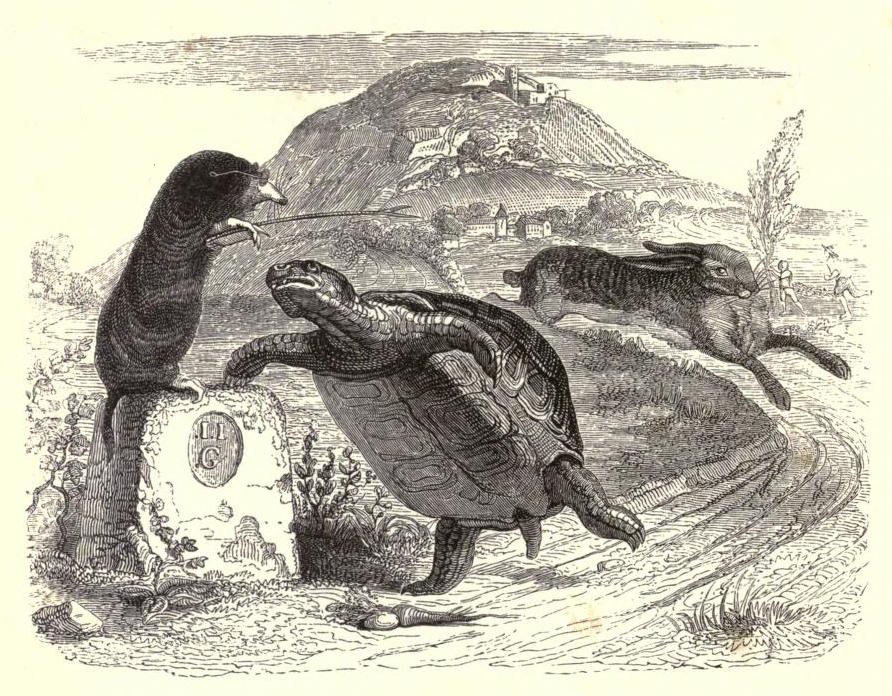
Today I’ve got a story about some new research into evolvability–the potential to reach new adaptations. Scientists have explored the possibility of evolvability for some time now, but mostly through analyzing mathematical equations. Now a new study offers a fine-grained picture of evolvability in action.Richard Lenski of Michigan State and his colleagues have watch evolvability help one line of bacteria beat out another one. It’s a Darwinian story of the tortoise and the hare. Check it out.

(For more on evolvability, check out this review by Massimo Pigliucci [pdf])

[Image: Wikipedia]

Originally published March 21, 2011. Copyright 2011 Carl Zimmer.

Earlier this month I was invited to deliver a keynote address at the Joint Summit on Translational Science in San Francisco. The meeting brings together scientists who seek to master the rising tide of biological data, in order to find new medical treatments. I urged them to think like ecologists, and treat the human body like an ecosystem of thousands of species.

I recorded my talk on my trusty iPhone, and I’ve posted the audio below. (You can download it.) It’s also here.

Continue reading “Dive into your inner lake: My keynote lecture on the microbiome (slides and audio)”

Charles Darwin pictured evolution as a grand tree, with the world’s living species as its twigs. Scientists identify 10,000 new species a year, but they’ve got a long, long way to go before finding all of Earth’s biodiversity. So far, they have identified 1.5 million species of animals, but there may be 7 million or more in total. Beyond the animal kingdom, our ignorance balloons. Scoop up some sea water or a cup of soil, and there will likely be thousands of new species of microbes lurking there. Fortunately, a lot of the species that scientists discover each year are fairly close relatives to species we already know about. There may be plenty of beetle species left to be discovered, for example, but they will all end up as tufts sprouting from the same beetle branch.

Continue reading “Glimpses of the Fourth Domain?”

Last year I wrote about how Craig Venter and his colleagues had inscribed a passage from James Joyce into the genome of a synthetic microbe. The line, “To live, to err, to fall, to triumph, to recreate life out of life,” was certainly apropos, but it was also ironic, since it is now being defaced as Venter’s microbes multiply and mutate.

Turns out there’s an even weirder twist on this story. Reporting from SXSW, David Ewalt writes about a talk Venter just gave. Venter recounted how, after the news of the synthetic microbe hit, he got a cease-and-desist letter from the Joyce estate. Apparently, the estate claimed he should have asked permission before copying the language. Venter claimed fair use.

Continue reading “Copyright law meets synthetic life meets James Joyce”