From time to time, I get letters from people thinking seriously about becoming science writers. Some have no idea how to start; some have started but want to know how to get better. I usually respond with a hasty email, so that I can get back to figuring out for myself how to be a science writer. I thought it would be better for everyone—the people contacting me and myself—to sit down and write out a thorough response. (I’m also going to publish a final version of this on my web site, here.)

First a caveat: I am probably the wrong person to ask for this advice. I stumbled into this line of work without any proper planning in the early 1990s, when journalism was a very different industry. The answer to “How do I become a science writer?” is not equivalent to “How did you become a science writer?”

Continue reading “A Note To Beginning Science Writers”

One of the great triumphs of twentieth-century biology was the discovery of how genes make proteins. Genes are encoded in DNA. To turn the sequence of a gene into a protein, a number of molecules gather around it. Reading its sequence, they produce a single-stranded version of it made of RNA, called a transcript. The transcript gets shipped to a cluster of other molecules, the ribosome, which picks out building blocks to construct a protein that corresponds to the gene. The protein floats off to do its job, whether that job is to catch light, digest food, or help generate a thought.

We have about 20,000 protein-coding genes. If you tally up the amount of DNA they constitute, you get less than 3 percent of the human genome. Which naturally raises the question of what’s in the other 97 percent.

Continue reading “Listening to the Genome: Music or Noise?”

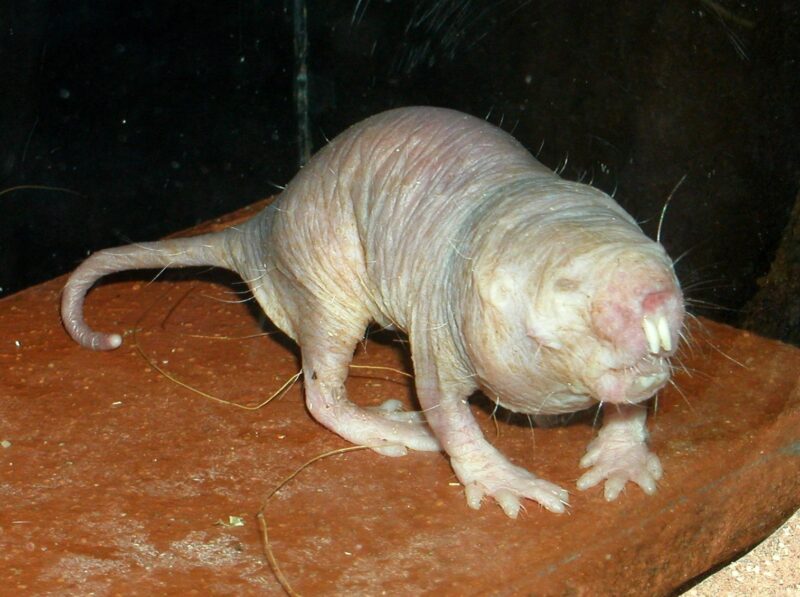
At this weekend’s Cancer and Evolution meeting, one of the highlights was a talk from a husband-and-wife team of biologists at Rochester University about naked mole rats. As far as scientists can tell, naked mole rats don’t get cancer, despite living up to 30 years. That’s pretty remarkable when you consider that another rodent–the lab mouse–has a 47% cancer rate during its brief, two-year life.

So a number of researchers have been searching the biology of naked mole rats for their secret. The Rochester scientists may have found a crucial ingredient in their cancer defense. And, by happy coincidence, Nature is publishing their report today. That’s the subject of my “Matter” column this week. Check it out.

Originally published June 19, 2013. Copyright 2013 Carl Zimmer.

Millions of years ago, some bats gave up their old habits of hunting for insects and tried something new: drinking blood. These creatures evolved into today’s vampire bats, and it’s mind-boggling to explore all the ways that they evolved to make the most of their sanguine meal.

A lot of the adaptations are easy enough to see with the naked eye. Vampire bats have Dracula-style teeth, for example, which they use to puncture the tough hide of cows. When they open up a crater-shaped wound, they dip in their long tongue, which contains two straw-shaped ducts that take up the blood. Continue reading “Dracula’s Children”