If the world goes crazy for a lovely fossil, that’s fine with me. But if that fossil releases some kind of mysterious brain ray that makes people say crazy things and write lazy articles, a serious swarm of flies ends up in my ointment.
Author: Matt Kristoffersen
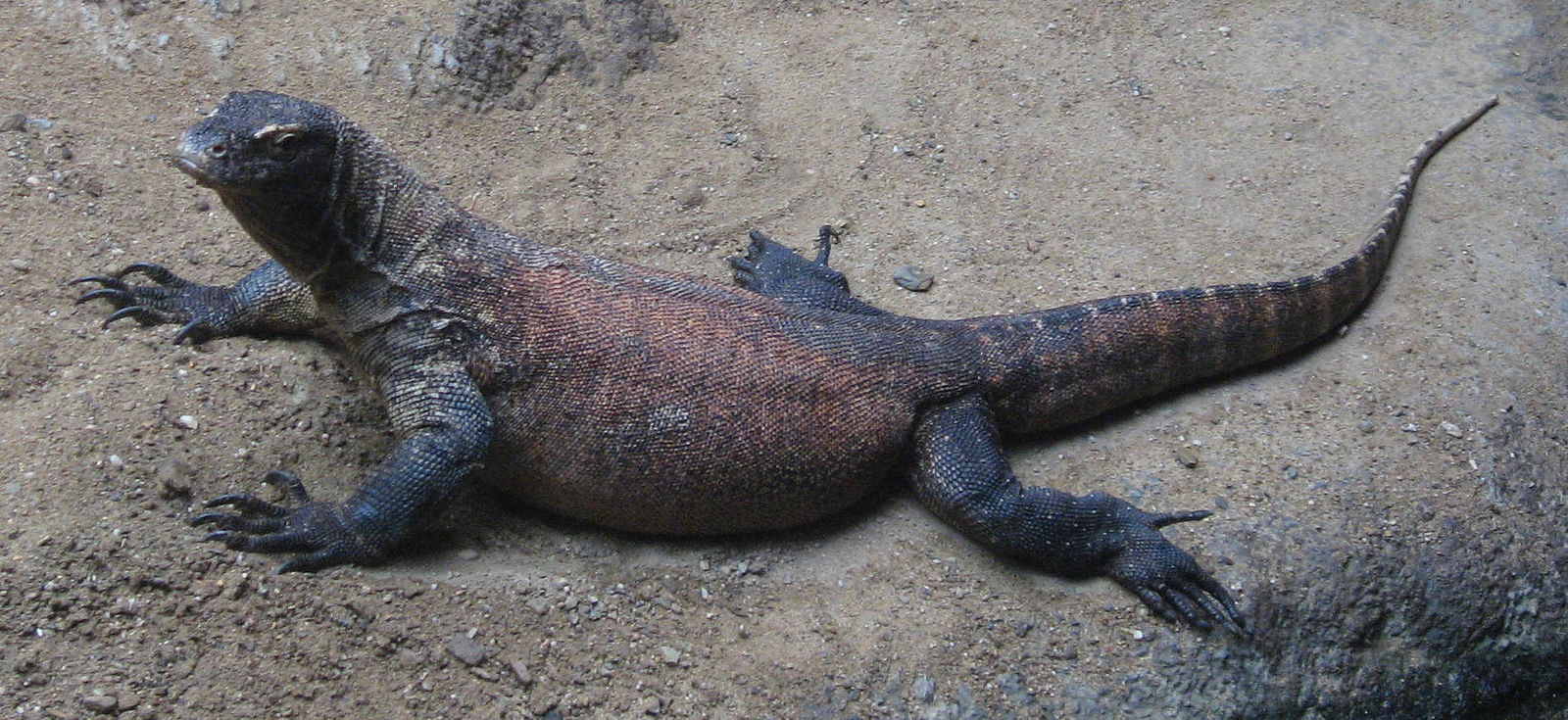
Readers of the Loom may be familiar with the work of Bryan Fry, who studies the evolution of snake venom. (See these two previous posts on his work.) I’ve got an article in tomorrow’s New York Times about his latest paper, to be published this week in the Proceedings of the National Academy of Sciences. In it, Fry and a big team of collaborators argue that Komodo dragons, the biggest lizards on Earth, are venomous. (There wasn’t room in the story to describe their argument that an extinct relative of Komodos that measured 21 feet long, was venomous too.) Provocative stuff, to be sure, and certainly not universally embraced by other researchers. I got some highly spicy quotes from critics. Check it out.
(PS: When the paper is put online this week, you’ll be able find it here: http://www.pnas.org/lookup/doi/10.1073/pnas.0810883106 )
[Image from Wikipedia]
Originally published May 18, 2009. Copyright 2009 Carl Zimmer.
Donovan, a biologist from Brazil writes, “My tattoo talks about the real scientific spirit. It’s a phrase in Portuguese of Isaac Newton: ‘If I have seen further it is only by standing on the shoulders of giants.'”
Click here to go to the full Science Tattoo Emporium.
Originally published May 16, 2009. Copyright 2009 Carl Zimmer.
This year marks the fortieth anniversary of the publication of Philip Roth’s novel Portnoy’s Complaint. In 1969, the book also became fodder for one of the oddest ideas in neuroscience: the grandmother cell. What if a neuron in your head only responded to the sight of your grandmother? For a long time, many neuroscientists have dismissed it out of hand. And yet the idea will not quite die.
Earlier this year a psychologist published an intriguing review of the grandmother cell, arguing that we should not be so hasty to run its obituary. Other scientists I’ve spoken to don’t think grandmother cells actually exist, but their own ideas about how we recognize individuals are equally fascinating. I’ve put together what I’ve learned about Philip Roth’s unexpected contribution to neuroscience in my latest Brain column for Discover. You can read it here.
Originally published May 15, 2009. Copyright 2009 Carl Zimmer.
Mental Floss has a nice two-post line-up of the weirdest mind-controlling parasites that we know of (1, 2). Some will no doubt be familiar to readers of the Loom, but others may be disturbingly new.
Update: Also check out Discover’s own gallery of parasitic horrors.
Originally published May 15, 2009. Copyright 2009 Carl Zimmer.