Viruses that infect bacteria–known as bacteriophages–are the most abundant living things on Earth. (Yeah, that’s right. I called viruses living things. You gotta problem with that?) For nearly a century, doctors and scientists have dreamed of using them as medical weapons against the microbes that make us sick. Over at the University of Chicago Press’s blog, I discuss the enduring dream of phage therapy with MIT phage engineer Tim Lu, whom I profiled last year for Technology Review. This is my third UCP blog post to celebrate the publication of A Planet of Viruses; the next and last will appear next Friday.

Originally published May 20, 2011. Copyright 2011 Carl Zimmer.
As I wrote on Monday, we’re boxing up books in preparation for some house renovations. You were kind enough to take 21 autographed paperback copies of At the Water’s Edge off our hands–in about three hours.

Well, we have even more books that we’d rather sell than pack.

Continue reading “We purge, you save! Get an autographed hardcover copy of Microcosm”

The World Science Festival is gearing up for its third year in New York, and I’m delighted to participate once more. This time I’ll be talking about a topic near and dear to my heart–telling stories about science. On Thursday June 2, they’ll have a full day of scientist-writers, television producers, and science writers.

Continue reading “The art of storytelling at the World Science Festival”

Our neurons exist in a staggering vast network, with 100 billion cells forming some 100 trillion connections. And it’s up to these ordinary cells to form that network on their own, snaking across the brain or even across the body, in order to find the right target. In my latest column for Discover, I look at new research that reveals some of the elegantly simple tricks our nervous system uses to wire itself. Check it out.

Originally published May 18, 2011. Copyright 2011 Carl Zimmer.

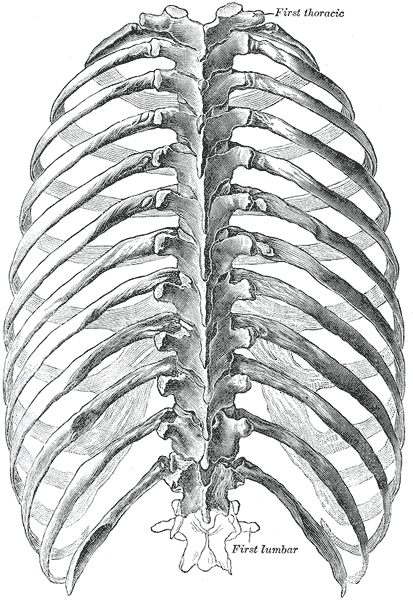
Biomechanics is the science of flesh and bone–how birds fly, sharks swim, muscles twitch, and tendons spring. In January, I went to a fascinating session at the annual meeting of the Society for Integrative and Comparative Biology where biomechanics experts talked about how they’ve been trying to turn their insights about biomechanics into commercial products. One of the most surprising examples came from Charles Pell, a North Carolina inventor, who explained how surgical tools could be much improved by taking biomechanics into account. I later paid Pell a visit at the offices of his company, Physcient, to find out more about their first creation: a rib spreader that promises to spread ribs without breaking them. The result was an article which appears in today’s New York Times. Check it out.

[Image: Gray’s Anatomy]

Originally published May 17, 2011. Copyright 2011 Carl Zimmer.