Thanks to everyone who scooped up autographed copies of At the Water’s Edge (72 are out the door as of this writing, and 8 are left). My shelves are getting close to being purged of author’s copies–which is good, since those shelves are about to come crashing down for some home renovation.

Continue reading “Soul-Made-Flesh-A-Thon: A Sale to Clear Out the Brain”

[Note: Some folks don’t like the phrase “chlorine-based life.” I welcome suggestions in the comments for a better shorthand descriptor]

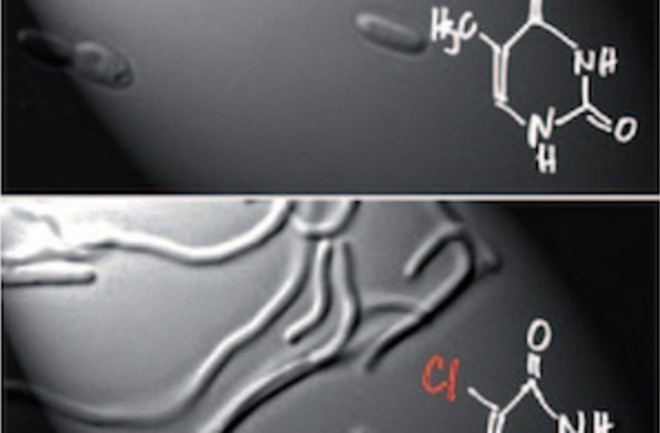
Last year, a team of NASA-funded scientists claimed to have found bacteria that could use arsenic to build their DNA, making them unlike any form of life known on Earth. That didn’t go over so well. (See my two pieces for Slate for a quick recap: #1, #2.) One unfortunate side-effect of the hullabaloo over arsenic life was that people were distracted from all the other research that’s going on these days into weird biochemistry. Derek Lowe, a pharmaceutical chemist who writes the excellent blog In the Pipeline, draws our attention today to one such experiment, in which E. coli is evolving into a chlorine-based form of life.

Continue reading “Last year: Arsenic life. This year: Chlorine life?”

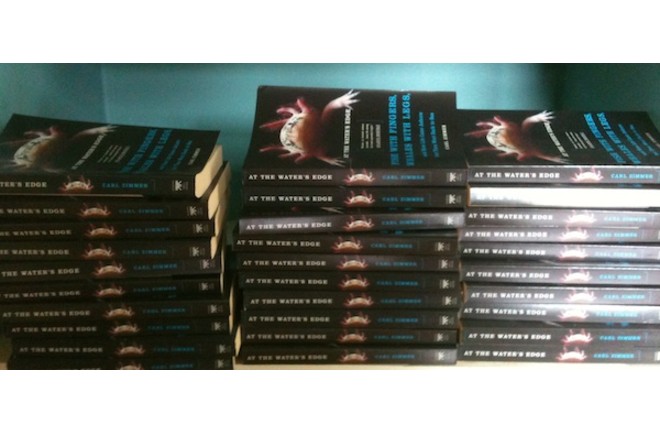
Having just returned from a ten-day family reunion road trip, I discovered a surprise in our attic: several extra boxes of my first book, At the Water’s Edge. You may recall that I put a bunch of autographed copies of this book on sale in my Amazon store to clear them out in advance of my office getting ripped apart. Well, the ripping-apart is now just days away, and now I have eighty more copies to get out of this house. (This photo shows just a selection.)

So–help! For the next week, you can get an autographed copy for six bucks. Order it here.

Continue reading “Fourth-of-July Secrets-in-the-Attic Book Sale!”

It’s been very gratifying to listen to the conversation that’s been triggered by my essay in this Sunday’s New York Times on scientific self-correction. Here, for example, is an essay on the nature of errors in science by physicist Marcelo Gleiser at National Public Radio. Cognitive scientist Jon Brock muses on how to get null results published.

Continue reading “De-discovery round-up (plus a correction)”

Some people get a thrill from getting their genome sequenced and poring through the details of their genes. I’m a bit off-kilter, I guess, because I’m more curious about the genomes of the things living in my belly button. And let me tell you: it’s a jungle in there.

I first became curious about my navel in January. I was in Durham, North Carolina, to attend a meeting, and as I walked out of a conference room I noticed a cluster of people in the lobby handing out swabs. They were asking volunteers to stick the swabs in their belly button for the sake of science. Our bodies are covered with microbes, and scientists are discovering weirdly complex patterns to their biodiversity. From fingers to elbows to chin to forehead, different regions of our skin are dominated by different combinations of species. But the bellybutton remained terra incognita.

Continue reading “Discovering my microbiome: “You, my friend, are a wonderland””