Rosie Redfield of the University of British Columbia has steadfastly raised doubts about the headline-grabbing news about arsenic-based life last November. (If neither arsenic life nor Rosie Redfield ring any bells for you, check out my two pieces for Slate, in December and June.) Redfield then did something exceptional: she set out to replicate the initial findings, getting the original bacteria and seeing whether they can build DNA from arsenic when deprived of phosphorus.

And then she did something quite unique: she started to chronicle her experiences on her blog. It’s a fascinating peek into the lab notebook of a practicing scientist. Today’s post is especially intriguing:

Continue reading “Did Rosie Redfield just refute #arseniclife on her blog?”
Last month I contemplated the staggering diversity of microbes in my bellybutton–an experience made possible by my participation in a survey of microbiome diversity carried out by scientists at North Carolina State University. At the time, I thought I was quite the host. I was informed there were 53 species living in my navel, some of which had never been seen on skin before and some of which were altogether new to science. I was even informed that I was a “wonderland.”

Well, the project is moving forward at quite a clip, and the scientists are starting to push more of their data online. Here you can see the species from the first 60 volunteers they’ve studied. The lists are coded by number–I’m B944. I appear to have lost a species so I’m down to 52. And 52 is, I’m seeing, nothing to blog home about. So far, the diversity champion is the anonymous owner of bellybutton B1288. 107 species! Now that’s a wonderland….

Originally published July 30, 2011. Copyright 2011 Carl Zimmer.

If you or someone you know is a student at Yale, check out the class I’m teaching this fall. It’s called Writing about Science and the Environment (cross-listed as EVST 215 and ENGL 459). You can find out about it on the Yale Online Course Information site, where I’ve just posted the syllabus.

Originally published July 28, 2011. Copyright 2011 Carl Zimmer.

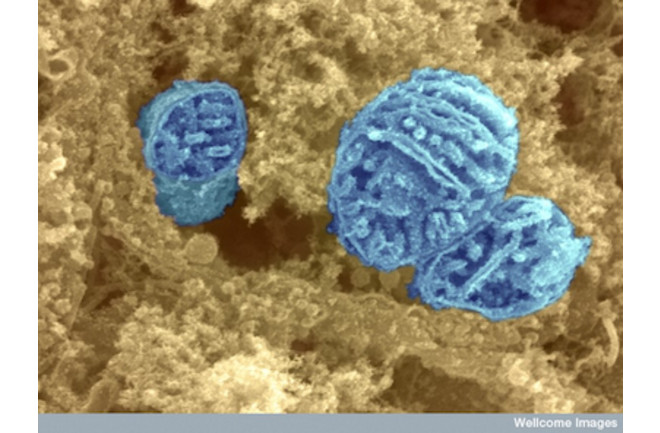
Our cells are packed with various protein-stuffed sacs, each dedicated to carrying out essential tasks. One kind of organelle is peculiar, though. Mitochondria are jellybean-shaped structures whose jobs include making the fuel that our cells use to power everything they do. What makes mitochondria strange is that they carry their own DNA. It’s not a lot of DNA–just 37 genes–but mitochondria can make extra copies of it as they grow and divide. In other words, they act an awful lot like bacteria.

Continue reading “The ocean microbe within us”

The human brain is, for want of a better word, ginormous. Sure, it’s only about as big as a cantaloupe, but it’s made of the hungriest cells in the human body. Keeping the brain supplied with energy is a huge challenge. In my new column in Discover, I describe how scientists have discovered some of the molecular tricks we’ve evolved to feed our neurological beast. Check it out.

Originally published July 26, 2011. Copyright 2011 Carl Zimmer.