The biggest animals on Earth–the biggest animals to have ever lived, in fact–are baleen whales. They can grow to over 100 feet long thanks in part to their ability to snarf colossal amounts of food. To do so, they swing open their toothless lower jaws, which inflate like a parachute with water. Then they haul their lower jaw shut again and then use a titanic tongue to push out a school bus worth of water through a filter. The filter is baleen: a set of fronds that hangs from their upper jaws. They trap shrimp and other tiny creatures in the baleen, which the whales then swallow before preparing for the next gulp. Each one of these operations can snag a blue whale up to half a million calories.
Author: Matt Kristoffersen
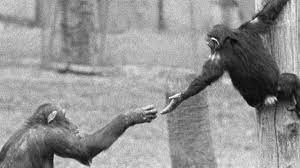
In tomorrow’s New York Times, I take a look at a new study on the generosity of chimpanzees. Check it out. (And also check out Ed Yong’s take at Not Exactly Rocket Science.)
[Image courtesy of Frans de Waal]
Originally published August 8, 2011. Copyright 2011 Carl Zimmer.
I learned that Google has retooled its invitation system for Google+. Instead of manually adding names into a message field, I can just drop a link into this post and offer 150 invitations. So if you want to dabble in this new experiment in social media and enforced non-pseudonymity, please click here.
Originally published August 8, 2011. Copyright 2011 Carl Zimmer.
[If you can’t see this post here, you can see it on Storify here.]
View “Greenfieldism” on Storify
Originally published August 7, 2011. Copyright 2011 Carl Zimmer.

To understand how we evolved, we have to understand where we evolved. Natural selection exists because the environment is kinder to some individuals than others. Depending on the species, that environment may be a lake miles underneath Antarctic ice, an alpine meadow near the top of a mountain, or an oxygen-free swamp in the sweltering tropics. Each habitat creates its own set of conditions in which individuals thrive or die. We humans are no different. We are the product of where we have lived.
Continue reading “What Home Looked Like For Seven Million Years”