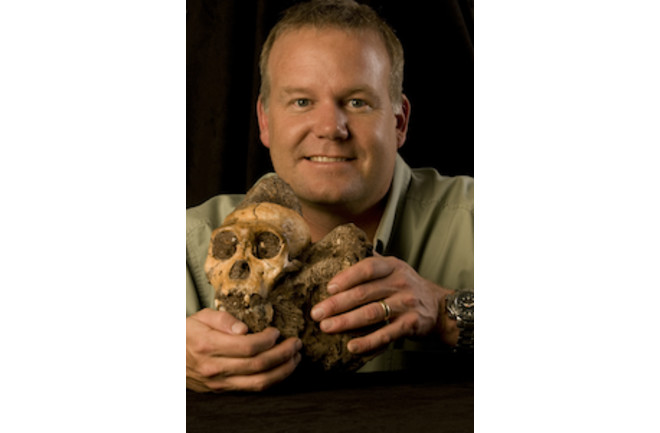
If you were this man, you’d be smiling too.

The man is Lee Berger, a paleoanthropologist at the University of Witwatersrand in South Africa. He’s holding the skull of Australopithecus sediba, a 1.98 million year old relative of humans, otherwise known as a hominin. In April 2010 Berger and his colleagues first unveiled the fossil in the journal Science. As I wrote in Slate, Berger argued that A. sediba was the closest known cousin to our genus Homo. Hominins branched off from other apes about 7 million years ago, but aside from becoming bipedal, they were remarkably like other apes for about five million years. Among other things, they were short, had long arms, and had small brains. Berger and his colleagues saw in A. sediba what biologists often find in transitional forms–a mix of ancestral and newer traits. It has Homo-like hands, a projecting nose, and relatively long legs. It was intermediate in heigh between earlier hominins and the tall Homo. And it still had a small brain and long arms. (In August, Josh Fishman wrote a feature for National Geographic on A. sediba, complete with excellent reconstructions.)

Continue reading “The Verge of Human”

I’m among the 800,000 people in Connecticut without power thanks to Irene, so I won’t be blogging much for the foreseeable future. But before I get to other matters like dragging branches around, let me point you to my latest piece for Yale Environment 360. I take a look at a new concept called the climate relict. Around the world, there are pockets of plants and animals living hundreds of miles away from their main species ranges. They were left behind in refuges at the end of the last Ice Age, as others moved towards the poles in response to the warming climate. As the climate now warms even more, climate relicts have a lot to teach us about how to manage biodiversity. Check it out.

[Update: bad link to Yale e360 fixed]

Originally published August 29, 2011. Copyright 2011 Carl Zimmer.

Before Irene takes away my Internet connection, let me point you to part two of my interview on Science Talk, the podcast of Scientific American. (If you missed it, here’s part one.)

Talk you on the other side of the maelstrom.

[Update: Part one linked now fixed]

Originally published August 27, 2011. Copyright 2011 Carl Zimmer.

Steve Mirsky, host of the excellent Science Talk, a podcast at Scientific American, talked to me the other day about all sorts of things. Part one of our talk is now online. We talk about my recent story about evolution in New York City. (Scientific American has a special issue dedicated to cities this month.) Listen to the podcast here.

Steve will be posting the second part of the talk soon.

Originally published August 25, 2011. Copyright 2011 Carl Zimmer.

It’s been a while since we’ve treated to the spectacle of Ann Coulter lecturing about evolution, but she’s at it again. She’s just written an op-ed in the wake of Rick Perry’s recent statement that Texas teaches evolution and creationism [his word] because evolution is “just a theory out there.”

Coulter takes this opportunity to remind us that she dedicated a third of her 2006 book Godless to demolishing evolutionary biology. Apparently the scientists who have published over 59,000 papers on the topic of evolution since she published her book didn’t get the memo.

Continue reading “Ann Coulter Nostalgia: Behold, For *I* Am The Giant Flatulent Raccoon”