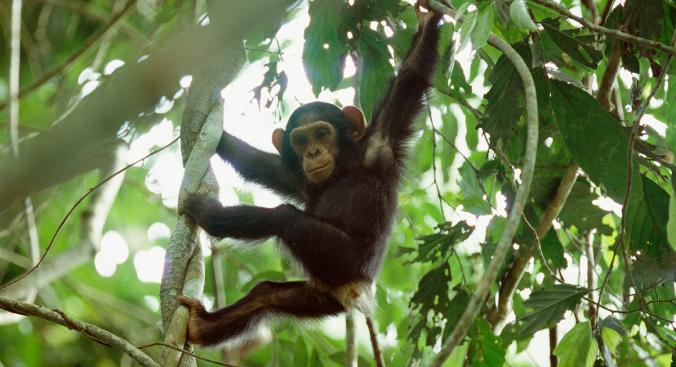
CHIMPANZEE. MICHAEL NICHOLS/NATIONAL GEOGRAPHIC

The food you ate today for breakfast has been transformed. Your body has used some of it to generate energy and some to build new tissues. Your body controls your metabolism in a marvelously sophisticated way, channeling resources to each organ to keep it functioning. In my new “Matter” column for the New York Times, I look at how our metabolism evolved. It turns out that our brains and our muscles have an odd kind of metabolism compared to other mammals. Did we lose muscular strength to fuel a big brain? Or did we switch our muscles to a different kind of metabolism, which let our brains burn brighter? The answer’s not clear yet, but the research is pretty cool. Check it out.

Originally published May 27, 2014. Copyright 2014 Carl Zimmer. 
The New York Times, May 27, 2014

Link

All animals do the same thing to the food they eat — they break it down to extract fuel and building blocks for growing new tissue. But the metabolism of one species may be profoundly different from another’s. A sloth will generate just enough energy to hang from a tree, for example, while some birds can convert their food into a flight from Alaska to New Zealand.

For decades, scientists have wondered how our metabolism compares to that of other species. It’s been a hard question to tackle, because metabolism is complicated — something that anyone who’s stared at a textbook diagram knows all too well. As we break down our food, we produce thousands of small molecules, some of which we flush out of our bodies and some of which we depend on for our survival.

Continue reading “Stronger Brains, Weaker Bodies”

The New York Times, May 22, 2014

Link

Just a few centuries ago, Madagascar was home to a monstrous creature called the elephant bird. It towered as high as nine feet. Weighing as much as 600 pounds, it was the heaviest bird known to science. You’d need 160 chicken eggs to equal the volume of a single elephant bird egg.

The only feature of the elephant bird that wasn’t gigantic was its wings, which were useless, shriveled arms. Instead of flying, the elephant bird kept its head down much of the time, grazing on plants.

Scientists aren’t precisely sure when this strange creature became extinct, but it probably endured well into our human-dominated age.

Continue reading “A Theory on How Flightless Birds Spread Across the World: They Flew There”

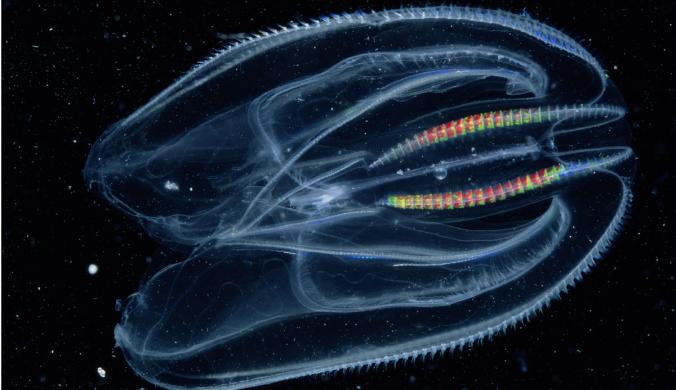
COMB JELLY. GEORGE GRALL/NATIONAL GEOGRAPHIC CREATIVE


In December, Ibloggedabout an animal most people have never heard of–the comb jelly. It’s a gorgeous, mysterious creature that just might belong to the oldest lineage of animals alive today. Today, over at National Geographic News, I’m reporting on a new study of the comb jelly that suggests it’s even more interesting than that. Unlike all other animals with a nervous system, it seems to have evolved nerves and a brain all its own. It even has its own special neurochemical language. If true, it’s about as close to an alien intelligence that we can encounter here on Earth.Check it out.

Continue reading “Another Kind of Brain”

National Geographic, May 21, 2014

Link

“It’s a paradox,” said Leonid Moroz, a neurobiologist at the University of Florida in Gainesville and lead author of a paper in today’s Nature about the biology of the comb jelly nervous system. “These are animals with a complex nervous system, but they basically use a completely different chemical language” from every other animal. “You have to explain it one way or another.”

The way Moroz explains it is with an evolutionary scenario—one that’s at odds with traditional accounts of animal evolution.

Continue reading “Strange Findings on Comb Jellies Uproot Animal Family Tree”