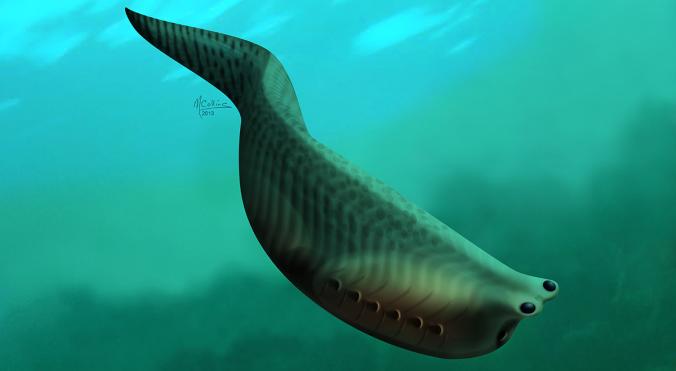
METASPRIGGINA, A 505-MILLION-YEAR-OLD FISH. DRAWING BY: MARIANNE COLLINS © CONWAY MORRIS AND CARON

I love writing about evolution’s great transitions–from water to land, from ground to air, and so on. For our species, one of the biggest of those transitions happened when our invertebrate ancestors became vertebrates–complete with our distinctive backbone, muscles, mouths, noses, and eyes. For fifteen years, I’ve been writing about this transition, and it’s been exciting to see more fossils come to light that help us understand how our inner fish got its start.  For mynew “Matter” column in the New York Times, I take a look at one of the most interesting of these fossils–what one scientist has dubbed a benchmark for our understanding of the first vertebrates. It’s called Metaspriggina, and here’s a video of an animated reconstruction. Get the rest of the story here.
Continue reading “Hello, Great-Great-Great-Aunt!”

The New York Times, June 11, 2014

Link

Half a billion years ago, a new study suggests, your ancestors may have looked like this:

This two-inch, 505-million-year-old creature belonged to the lineage that would later produce sharks, eels and other fish — along with birds, reptiles and mammals like us. This early vertebrate, known as Metaspriggina, was something of a mystery for years, known only from a pair of ambiguous fossils. But recently, scientists unearthed a trove of much more complete Metaspriggina fossils.

As they report today in the journal Nature, the new fossils offer a remarkably detailed understanding of the first vertebrates, helping scientists understand how major parts of our own anatomy — from eyes to jaws to our muscles — evolved.

Continue reading “A Long-Ago Ancestor: A Little Fish, With Jaws to Come”


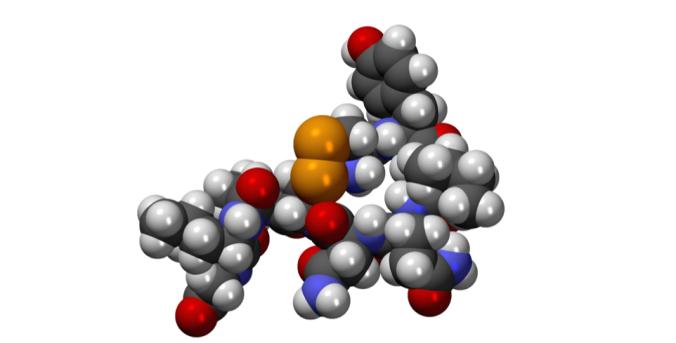
OXYTOCIN. MODEL VIA WIKIPEDIA

Last month, I wrote in the New York Times about a creepy yet potent way to reverse aging. All you have to do is join an old mouse to a young mouse. As the young mouse’s blood flows through the old mouse’s body, it rejuvenates the heart, skeletal muscle, and even the brain.

When scientists saw just how dramatic this reversal could be, they started investigating how it happens. They suspected that it wasn’t blood as a whole that was responsible for the transformation. Blood is a finely blended consommé of cells and free-floating molecules. It was possible that only certain compounds in young blood are required to counter aging. That would be excellent if true, since it would put a damper on any vampire-like strategies for applying this discovery to people. All old people would need to do was take a pill containing the compounds that bring about the change.

Continue reading “The Secret Ingredient in Young Blood: Oxytocin?”

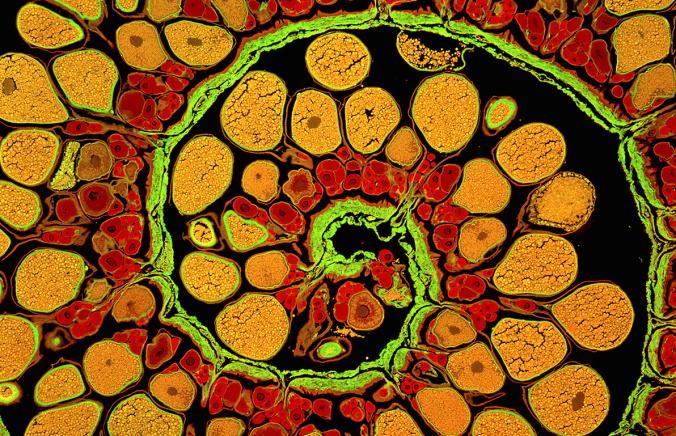
ANGLERFISH OVARY CROSS-SECTION. JAMES E. HAYDEN, THE WISTAR INSTITUTE, PHILADELPHIA, PA. SOURCE

If you travel through Dulles Airport in the near future, you may see some lovely scientific images on the walls. It’s an exhibit called “Life: Magnified,” organized by the National Institute of General Medical Sciences, the American Society for Cell Biology and the Metropolitan Washington Airports Authority’s Arts Program. If you aren’t passing through Dulles, you can see the images on the web.

Here are a few of my favorites. You can see high-resolution versions on the web site, plus many others.

Continue reading “Life Magnified”

CUP CORAL REEF, CALIFORNIA ACADEMY OF SCIENCES. WIKIPEDIA

The debates raging over how to deal with climate change often swirl around costs. Some warn that doing anything to stop our planet from warming will cost us dearly in jobs and revenue. Others warn that the cost of letting Earth get warmer is far more steep. It could flood cities, worsen droughts, and make it harder to grow food in many places.

Left out of these debates is the effect that climate change will have on nature–and the services that we depend on nature for. We take those services for granted, but if we damage the ecosystems that provide them, we’ll miss them. In my new “Matter” column for the New York Times, I take a look at how some scientists are trying to put a price tag on the global services of ecosystems, including protection against floods and erosion. If they’re right, the value is colossal–about twice the world’s gross product. Check it out.

Continue reading “The Value of Nature–to the Dollar?”